

Most founders learn how equity works the hard way, usually in the middle of a funding round when a small mistake from two years ago turns into a legal bill. Your cap table is the record of who owns what in your company. Get it right early and raising money stays boring in the good way. Get it wrong and you spend your Series A cleaning up instead of closing.
This guide walks through the parts of startup equity that actually matter, in plain terms, so you can make decisions now that your future investors and your future self will thank you for.
What a cap table is
A cap table, short for capitalization table, is the list of every ownership stake in your company. That includes founder shares, employee options, investor shares, SAFEs, convertible notes, and anything else that can turn into equity later.
In the first few months a spreadsheet does the job. By the time you have a few employees with options, a couple of SAFEs at different caps, and one priced round behind you, the spreadsheet becomes a risk. One wrong formula or one outdated version can throw off your ownership math, and that error tends to surface at the worst possible time, during investor diligence.
The building blocks of your equity
Founders often blur these together. Keeping them separate is most of the job.
Common stock. This is what founders and employees hold. It is plain ownership with no special rights attached.
Preferred stock. This is what investors get in a priced round. It comes with extra rights, usually around what happens to their money in a sale or a shutdown.
Options. These give an employee the right to buy shares later at a fixed price, called the strike price. Options are the standard way to give equity to your team.
Option pool. This is a block of shares you set aside for future hires. It usually sits somewhere between 10 and 20 percent of the company, and investors often ask you to top it up right before they invest. That top up comes out of your ownership, not theirs, so it is worth negotiating.
SAFEs and convertible notes. These are ways to raise money quickly without setting a price for your company yet. They convert into shares later, usually at your next priced round. More on how they hit your cap table below.
How ownership gets divided
At the start, founders own everything, split however you agree. From there, every round of hiring and fundraising chips away at that number. This is called dilution, and it is normal. Owning a smaller slice of a bigger, better funded company is the whole point.
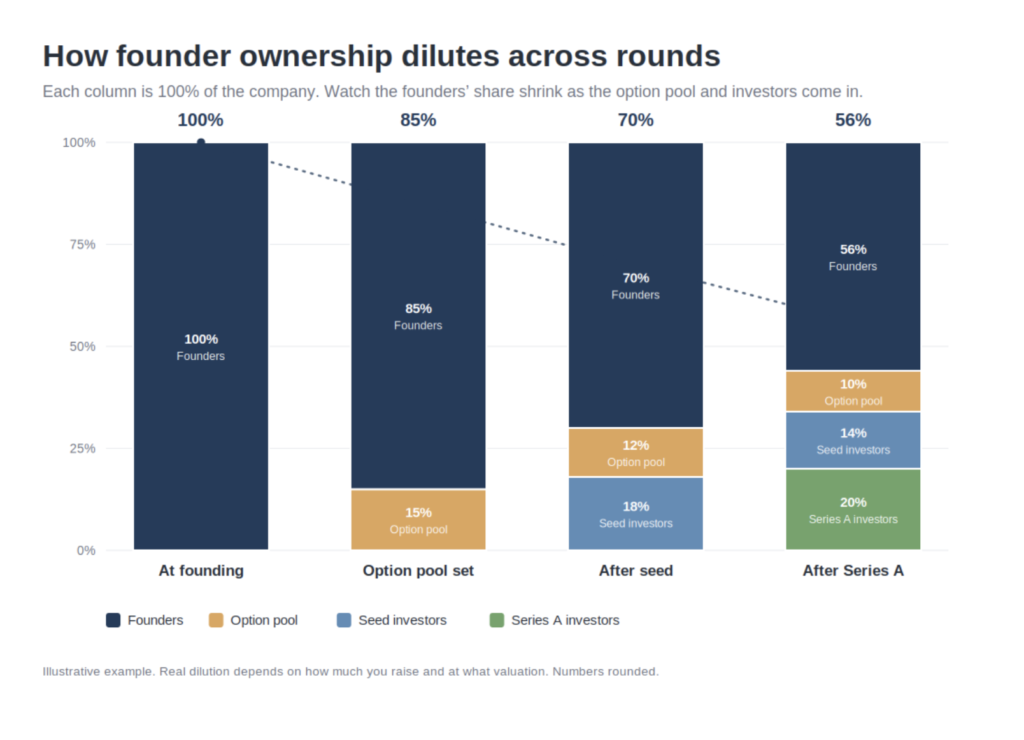
Here is the rough shape of it. Founders start at 100 percent. You carve out an option pool for the team. Then each raise hands a chunk to investors. A seed round often costs founders somewhere in the range of 10 to 20 percent, and a Series A commonly lands in a similar or slightly higher range, though the real number depends entirely on how much you raise and at what valuation. Treat those as rough guides, not promises.
The mistake to avoid is thinking about any single round on its own. Dilution stacks across rounds. A generous option pool plus a big seed plus a big Series A can add up faster than founders expect.
Vesting and the 83(b) election
Vesting means you earn your shares over time instead of getting them all at once. The standard schedule is four years with a one year cliff. The cliff means you earn nothing for the first year, then 25 percent at the one year mark, then the rest month by month after that. This applies to founders too, not just employees, and investors expect to see it.
Here is the part that trips people up. If you receive stock that is subject to vesting, you can file something called an 83(b) election with the IRS. It tells the IRS to tax you on the stock now, while it is worth almost nothing, instead of later as it vests and grows in value. For most founders this is a large tax saving.
The catch is the deadline. You have 30 calendar days from the date the stock is granted to file, and there are no extensions, ever. Miss it and you cannot fix it. As of 2025 you can file online through the IRS using Form 15620, which is simpler than the old paper method, but the 30 day clock is exactly the same. File within the first week or two to give yourself margin.
SAFEs and convertible notes
Early on, most US startups raise on SAFEs. A SAFE lets an investor give you money now in exchange for shares later, without either side having to agree on a company valuation today. It converts into equity at your next priced round.
The detail that matters most is the valuation cap. The cap sets the highest company value at which the investor’s money converts into shares. A lower cap means the investor gets more shares when conversion happens. Since 2018 the standard version from Y Combinator is the post-money SAFE, which calculates the investor’s ownership as a percentage of your company after all SAFEs convert. Post-money SAFEs are easier to add up, but they also dilute founders more than the older pre-money version, and that extra dilution is easy to underestimate when you stack several of them.
Convertible notes work in a similar way but are structured as debt, with interest and a maturity date. They were more common before SAFEs took over. If you are choosing today, most US seed investors expect a SAFE.
The thing to watch with both is what happens at conversion. Several SAFEs at different caps converting into the same round can move your ownership more than you planned. Model it before you sign, not after.
Priced rounds and dilution
A priced round is when you and your investors agree on an actual value for the company and they buy preferred stock at that price. This is usually your Series A and beyond, though some seed rounds are priced too.
Two numbers matter here. The pre-money valuation is what your company is worth before the new money goes in. The post-money valuation is the pre-money plus the new investment. The investor’s ownership is their check divided by the post-money valuation. So a 3 million dollar investment at a 12 million dollar post-money valuation buys 25 percent of the company.
This is also the round where all those earlier SAFEs convert into real shares. It is common for founders to be surprised at how much of the company is already spoken for once the SAFEs land and the new option pool is added on top.
409A valuations
A 409A valuation is an independent appraisal of what your common stock is worth. You need one to set the strike price on employee options at fair market value, which keeps those options from creating a tax problem for your team.
You need a 409A before you grant options after a priced round, and you need a fresh one every 12 months, or sooner if something material happens such as a new funding round. Some cap table platforms include 409A valuations in their pricing. Others send you to a third party that charges a few thousand dollars each time. If you plan to grant options in your first year, that difference adds up quickly.
QSBS and a tax rule worth knowing early
QSBS, short for Qualified Small Business Stock, is one of the biggest tax breaks available to founders and early employees. If your company qualifies and you hold your shares long enough, you can exclude a large share of the gain from federal tax when you sell. It applies to stock in US C-corporations, and some business types are excluded, so it is not automatic.
This rule changed in July 2025 under the One Big Beautiful Bill Act, and the new version is more generous, but only for stock issued after July 4, 2025. Here is the shape of it for that newer stock. Hold for at least three years and you can exclude 50 percent of the gain. Hold four years and it is 75 percent. Hold five years or more and it is 100 percent. The cap on the excluded gain rose to 15 million dollars, up from 10 million, and the size limit on a qualifying company rose to 75 million dollars in gross assets, up from 50 million.
Stock issued on or before July 4, 2025 still follows the old rules, which means a five year hold for any exclusion and a 10 million dollar cap. If you hold shares from both before and after that date, you now have two separate tax situations to track, which is one more reason to keep clean records. This is real money at exit, so it is worth a conversation with a tax advisor early rather than late.
How founders break their own cap tables
The same handful of mistakes show up again and again.
Missing the 83(b) deadline. The 30 day window is unforgiving and the tax cost is real.
Handshake equity. Promising someone shares in a conversation, or over email, with no paperwork behind it. When it comes time to formalize the grant, the two sides rarely remember the terms the same way.
Stacking SAFEs without modeling them. Raising on several SAFEs at different caps and only discovering the combined dilution at the priced round.
Letting the cap table go stale. Not recording option grants, exercises, or transfers as they happen, then trying to rebuild the record under deadline pressure during diligence.
None of these are hard to avoid. They are just easy to postpone.
When to move off a spreadsheet
A spreadsheet is fine at the very start. The point where it stops being fine is roughly your first real option grants or your first outside investor, because that is when the number of moving parts and the cost of an error both jump at once.
Cap table software automates the dilution math, tracks vesting, keeps your 409A and filings in one place, and gives investors a clean export during diligence. The market is competitive in 2026, with strong options at every stage and price point. One recent shift is worth noting if you are picking a tool now. In August 2025, AngelList stopped taking new customers for its standalone Stack cap table product and named Pulley and J.P. Morgan Workplace Solutions as migration partners, so Stack is no longer a starting option for new companies.
If you want the full breakdown of which tool fits which stage, read our guide to the best cap table management software.
The bottom line
Equity is not complicated once you separate the parts. Shares, options, pools, SAFEs, and priced rounds each do one job. Vesting and the 83(b) election protect you early. The 409A keeps your option grants clean. QSBS can save you a lot at the end if you set it up right. And keeping the record accurate, from day one, is what turns your next raise into a formality instead of a fire drill.
Start simple, keep it current, and move to real software the moment your equity runs longer than a single page.
