
Q2 2026 did not top Q1’s record, but it came close, and the story underneath the numbers changed. Investors put around $205 billion into startups worldwide, the second-largest quarter ever recorded. More than 70% of that went to AI companies, up from just under 50% a year earlier. Anthropic alone took close to a third of all global venture funding for the quarter with a single round. But unlike Q1, which was almost entirely about frontier model labs, Q2 spread the money wider: into defense, robotics, drug discovery, data centers, and satellite intelligence. Below are the 10 most funded AI and AI-adjacent startups of Q2 2026, ranked from the largest round raised to the smallest.
Key Takeaways
- Q2 2026 was the second-largest venture quarter on record, with roughly $205 billion raised across 5,000+ startups
- AI companies captured more than 70% of all global venture funding in the quarter
- Anthropic’s $65 billion Series H made it the most valuable private company in the world at $965 billion, passing both OpenAI and SpaceX
- 16 companies raised billion-dollar rounds in Q2, totaling $108.6 billion, or 53% of all funding for the quarter
- The money spread out from pure model labs into defense (Anduril), robotics (NEURA), biotech (Isomorphic), data centers (DayOne), and space (ICEYE)
- China showed up in force, with DeepSeek raising $7.4 billion and Moonshot AI raising $2 billion
- Inference infrastructure became the new battleground, with Baseten and Fireworks AI each raising $1.5 billion within weeks of each other
- Q2 was also the biggest quarter ever for billion-dollar acquisitions, headlined by SpaceX buying Cursor maker Anysphere for $60 billion
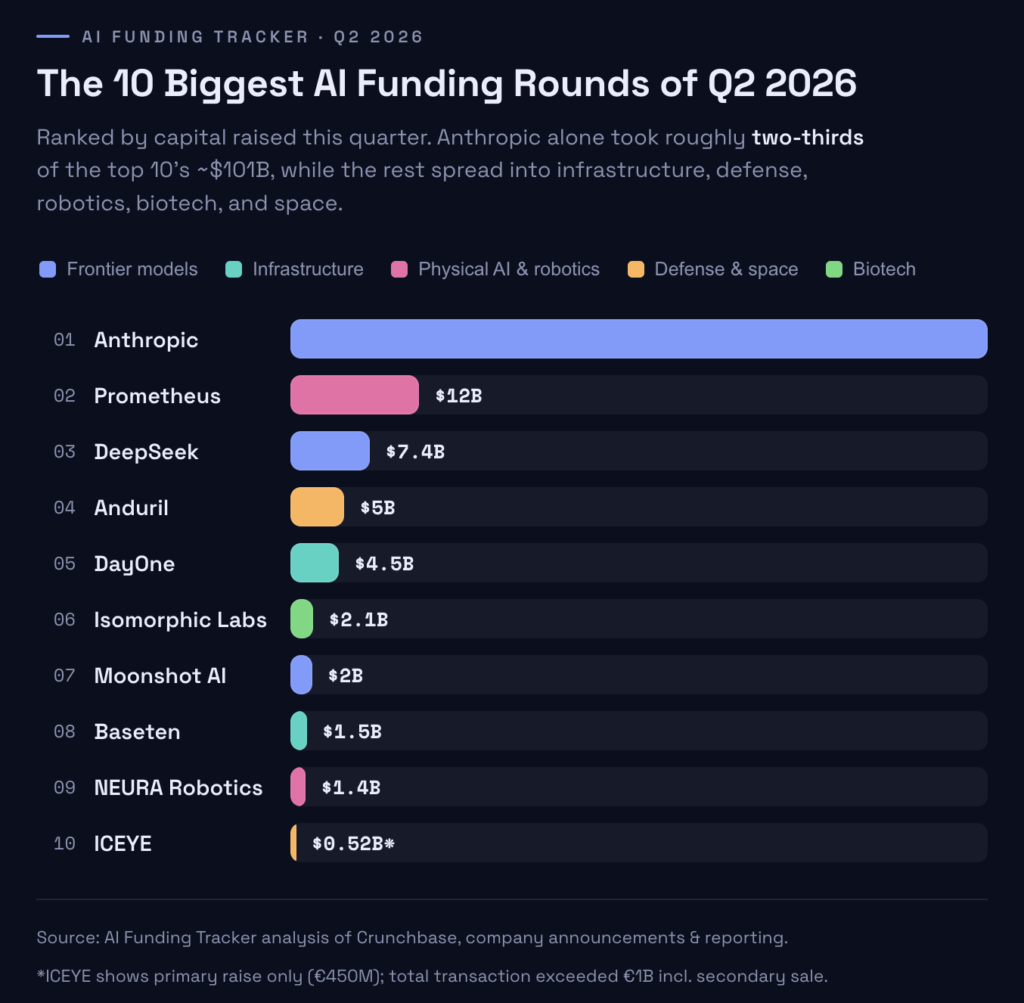
1. Anthropic
Total Funding: ~$132B+ | Latest Valuation: $965B | Round: $65B Series H (May 28, 2026)
Anthropic closed a $65 billion Series H on May 28 at a $965 billion post-money valuation, passing OpenAI to become the most valuable private company in the world. The round was co-led by Altimeter Capital, Dragoneer, Greenoaks, and Sequoia Capital, with each lead reportedly putting in more than $2 billion. Capital Group, Coatue, D1 Capital, GIC, ICONIQ, and XN joined as additional co-leads.
A big part of the story was who else showed up. Memory and compute suppliers Samsung, SK Hynix, and Micron all invested, which reads less like a financial bet and more like a supply chain lining up behind the hardware Anthropic needs to keep scaling. The round also folded in about $15 billion of previously committed hyperscaler money, including $5 billion from Amazon announced in April.
The company said its revenue run-rate had passed $47 billion by early May. Days after the round, Anthropic confidentially filed for an IPO, setting up a possible fall listing that could beat OpenAI to the public market. A Series H is rare in venture history to begin with. The short list of companies that ever reached one includes Facebook, Lyft, and Slack.
Key Investors: Altimeter Capital, Dragoneer, Greenoaks, Sequoia Capital, Capital Group, Coatue, GIC, ICONIQ, Amazon, Samsung, SK Hynix, Micron
2. Prometheus
Total Funding: $18B+ | Latest Valuation: $41B | Round: $12B Series B (June 11, 2026)
Prometheus is Jeff Bezos’s industrial AI startup, and its $12 billion Series B was one of the largest private rounds of the year. It valued the company at roughly $41 billion and pushed total funding past $18 billion in under a year of existence. Bezos co-leads the company as CEO alongside Vik Bajaj, a Verily co-founder, and this is his first operating role since leaving Amazon in 2021. Investors include JPMorgan, Goldman Sachs, BlackRock, DST Global, Arch Venture Partners, and Bezos himself.
The company is building what it calls an “artificial general engineer,” an AI system meant to take a complex physical product like a jet engine from first design all the way through to manufacturing. This is not a chatbot. It is aimed at the physical world, treating the whole design-to-build pipeline as one AI problem.
Prometheus has around 150 employees across San Francisco, London, and Zurich, and has hired from OpenAI, Google DeepMind, and Nvidia. It has not disclosed revenue and has named only Blue Origin as an early customer. Bezos told CNBC the round was raised largely to buy more compute.
Key Investors: Jeff Bezos, JPMorgan, Goldman Sachs, BlackRock, DST Global, Arch Venture Partners
3. DeepSeek
Total Funding: ~$7.4B | Latest Valuation: $50B+ | Round: $7.4B (June 2026)
DeepSeek raised more than 50 billion yuan, about $7.4 billion, in its first ever external funding round, at a valuation above $50 billion. For a company that ran on its founder’s own hedge fund money until now, that is a major shift. The round was reportedly led by Tencent, with around $1.5 billion, and battery giant CATL, with roughly $735 million. China’s state-backed AI fund was the only investor granted direct equity and voting rights.
The deal came with unusual terms. Outside investors put their money into a limited partnership run by founder Liang Wenfeng rather than into the company directly, took no voting rights, and agreed to a five-year lock-up. It is a structure built to keep control firmly in the founder’s hands.
DeepSeek stunned the industry in 2025 with low-cost models that matched far more expensive US systems. Its open-weight strategy keeps pressure on the whole market, forcing rivals to compete on cost, not just raw capability. It is doing all of this at a fraction of Anthropic’s or OpenAI’s valuation.
Key Investors: Tencent, CATL, China’s National AI Industry Investment Fund, Liang Wenfeng
4. Anduril Industries
Total Funding: $11B+ | Latest Valuation: $61B | Round: $5B Series H (May 13, 2026)
Anduril raised a $5 billion Series H on May 13, doubling its valuation to $61 billion in less than a year. The round was led by returning backers Thrive Capital and Andreessen Horowitz, and it came in about $1 billion higher than the raise the market expected. Total funding now sits above $11 billion across eight rounds.
The defense tech company builds AI-driven autonomous systems for the US military and its allies, from drones and counter-drone interceptors to its Lattice command software. CEO Brian Schimpf tied the raise to rising demand as the US and its allies deal with great-power competition and the shift toward autonomous warfare. The money is going into manufacturing, including its Arsenal-1 weapons factory in Ohio, plus R&D and infrastructure.
Anduril reported $2.2 billion in revenue for 2025, more than double the year before, and holds a $20 billion enterprise framework contract with the US Army. Its valuation has roughly doubled every year since 2022. The company still says an IPO is the goal, but not until the whole business is closer to profitable.
Key Investors: Thrive Capital, Andreessen Horowitz, Founders Fund, 8VC
5. DayOne Data Centers
Total Funding: ~$6.4B+ | Latest Valuation: $20B | Round: $4.5B Series C (June 5, 2026)
DayOne closed its Series C at $4.5 billion on June 5, more than doubling the round from its January first close, at a reported $20 billion valuation. The round was led by existing investors Coatue and Hillhouse, now the company’s two largest shareholders, with the Indonesia Investment Authority and Achi Capital Partners joining as new backers.
DayOne is a Singapore-based operator that builds and runs AI-ready data center campuses across Asia Pacific and Europe. It spun out of China’s GDS Holdings and has secured more than 1.5 gigawatts of capacity bookings since 2022. The new money funds expansion across Singapore, Malaysia, Indonesia, Thailand, Japan, and into Finland and Spain.
The round is a clear sign that AI funding has moved past software and into the physical layer that makes AI run. DayOne is also lining up a possible dual listing in Singapore and New York and chasing a corporate loan reported to be as large as $7 billion.
Key Investors: Coatue, Hillhouse, Indonesia Investment Authority, Achi Capital Partners
6. Isomorphic Labs
Total Funding: ~$2.7B | Latest Valuation: Undisclosed | Round: $2.1B Series B (May 12, 2026)
Isomorphic Labs raised $2.1 billion in a Series B on May 12, described by analysts as the second-largest biotech round ever. The round was led by Thrive Capital, with existing backers Alphabet and GV joined by new investors MGX, Temasek, CapitalG, and the UK government’s AI fund.
The London company was founded by Alphabet in 2021 to use AI to speed up drug discovery. It builds on the same science as AlphaFold 3, the Google DeepMind model that predicts how molecules fold and interact. Its in-house engine, IsoDDE, is meant to design potential drugs across many disease areas at once rather than chasing a single target.
The money will push IsoDDE forward and move Isomorphic’s own drug candidates toward the clinic. The size of the round, given the caution elsewhere in biotech funding, shows how much confidence sits behind AI-native drug design when it carries the DeepMind name.
Key Investors: Thrive Capital, Alphabet, GV, MGX, Temasek, CapitalG, UK Sovereign AI Fund
7. Moonshot AI
Total Funding: ~$3.8B | Latest Valuation: $20B | Round: $2B Series D (May 7, 2026)
Moonshot AI raised $2 billion in a Series D on May 7 at a $20 billion valuation, nearly doubling its worth from a few months earlier. The Beijing company is best known for its open-weight Kimi models, which have become some of the most used LLMs in the world for coding. Backers across its recent rounds include Alibaba, Tencent, Meituan, IDG Capital, and HSG.
The company was founded in 2023 by Yang Zhilin, a former Meta AI and Google Brain researcher. Its Kimi K2 series pushed China’s open coding models forward and posted benchmark numbers close to top US models at the time. By mid-2026 it had launched Kimi K3, one of the largest open AI models yet released.
Moonshot plans to use the new capital to cover the rising cost of training, buy compute, and grow its user base. The company is also reported to be preparing a Hong Kong IPO and removing its offshore structure, a move that would tie it more closely to China’s domestic markets.
Key Investors: Alibaba, Tencent, Meituan, IDG Capital, HSG, CPE
8. Baseten
Total Funding: ~$2B+ | Latest Valuation: $13B | Round: $1.5B Series F (Q2 2026)
Baseten raised $1.5 billion in a Series F, closing across two tranches at $13 billion and $11 billion valuations. The round was led by Altimeter Capital, Conviction, and Spark Capital, with Sands Capital and Wellington Management as co-leads, plus IVP, Greylock, Battery Ventures, and D.E. Shaw Ventures joining in.
The San Francisco company sits in the inference layer of AI. Its platform handles the messy work of running models in production: GPU orchestration, autoscaling, observability, billing, and developer tools. That lets companies mix frontier models with their own custom, fine-tuned ones without building the plumbing themselves.
Baseten’s raise was part of a clear Q2 trend. Capital rotated hard from model training toward inference serving, the part of the stack that actually delivers AI to end users at scale. Fireworks AI raised its own $1.5 billion round within weeks, making inference infrastructure one of the hottest categories of the quarter.
Key Investors: Altimeter Capital, Conviction, Spark Capital, Sands Capital, Wellington Management, IVP, Greylock, D.E. Shaw Ventures
9. NEURA Robotics
Total Funding: ~$1.68B | Latest Valuation: $7B | Round: $1.4B Series C (June 10, 2026)
NEURA Robotics announced a Series C of up to $1.4 billion on June 10 at a $7 billion valuation, which it calls the largest round ever for a full-stack robotics company. The German company, based in Metzingen near Stuttgart, builds what it calls cognitive robots, machines that combine hardware with AI so they can sense, learn, and adapt rather than just repeat fixed motions. Part of the funding is tied to performance milestones. The valuation is up from around $4 billion just eight months earlier.
The investor list says more than the dollar figure. The round was led by stablecoin issuer Tether, with Qualcomm, Amazon, Nvidia, Bosch, Schaeffler, the European Investment Bank, and imec.xpand all joining in. When Amazon and Nvidia show up in the same robotics round, it signals real belief in physical AI.
NEURA is best known for its 4NE-1 humanoid and its plan to bring cognitive robots into factories, warehouses, and eventually homes. It says its order book already tops $1 billion and is targeting 6,000 units in 2026, scaling toward millions by 2030. The raise makes it Europe’s most-funded humanoid maker in a race so far led by US and Chinese names.
Key Investors: Tether, Qualcomm, Amazon, Nvidia, Bosch, Schaeffler, European Investment Bank, imec.xpand
10. ICEYE
Total Funding: ~€663M prior + Series F | Latest Valuation: €10B+ (~$12B) | Round: €450M primary Series F, over €1B total (June 9, 2026)
ICEYE’s headline “€1 billion round” needs one clarification. The company raised €450 million ($520 million) in fresh primary Series F capital, led by General Atlantic. A secondary share sale, where existing shareholders sold stock to new investors, brought the total transaction above €1 billion. So the new money into the company is €450 million, not the full billion. The round valued ICEYE at more than €10 billion, about $12 billion, more than four times its December 2025 mark. Other investors include Nokia, the Qatar Investment Authority, TCV, and Finnish state-linked funds.
The Finnish company runs the world’s largest constellation of synthetic aperture radar satellites, which image the ground day or night and see through cloud cover. That makes it a key supplier of near-real-time intelligence for defense, disaster response, and insurance. It crossed €250 million in revenue in 2025 and was already profitable heading into the round.
Seven European governments have now bought sovereign satellite systems from ICEYE, and it delivered Poland’s constellation within 12 months of signing. Demand has surged since 2022 as European nations push for their own eyes in orbit. The company is doubling production from 50 satellites a year toward 100 by 2028.
Key Investors: General Atlantic, Nokia, Qatar Investment Authority, TCV, Solidium, Tesi, Varma, Ilmarinen, Lifeline Ventures
Q2 2026 by the Numbers
| # | Company | Q2 Round | Total Funding | Valuation |
|---|---|---|---|---|
| 1 | Anthropic | $65B | ~$132B+ | $965B |
| 2 | Prometheus | $12B | $18B+ | $41B |
| 3 | DeepSeek | $7.4B | ~$7.4B | $50B+ |
| 4 | Anduril | $5B | $11B+ | $61B |
| 5 | DayOne | $4.5B | ~$6.4B+ | $20B |
| 6 | Isomorphic Labs | $2.1B | ~$2.7B | Undisclosed |
| 7 | Moonshot AI | $2B | ~$3.8B | $20B |
| 8 | Baseten | $1.5B | ~$2B+ | $13B |
| 9 | NEURA Robotics | $1.4B | ~$1.68B | $7B |
| 10 | ICEYE | €450M primary | ~€663M prior | €10B+ (~$12B) |
What This Quarter Actually Means
The record totals are only half the picture. A few shifts stand out once you look at where the money went.
One company still dominates, but it is a different one. Anthropic’s $65 billion round took close to a third of all global venture funding for the quarter and made it the most valuable private company on earth. In Q1 that spot belonged to OpenAI. The frontier model race now has a new leader, and the gap between the top labs and everyone else keeps widening.
The money spread out. Q1 was almost entirely about foundation model labs. Q2 pushed capital into the whole ecosystem around AI: defense with Anduril, robotics with NEURA, drug discovery with Isomorphic, data centers with DayOne, and space intelligence with ICEYE. Investors have moved from backing the biggest models to funding everything those models need and everything they can be pointed at.
Inference became the new battleground. Baseten and Fireworks AI both raised $1.5 billion within weeks of each other. As companies move from testing AI to actually running it in production, the value is shifting from training models to serving them fast and cheap. That is where a lot of the next fight will happen.
China is competing on its own terms. DeepSeek and Moonshot AI together raised close to $10 billion, both with open-weight strategies and deal structures built to keep founders in control. They are doing it at a fraction of the valuations their US rivals command, and their open models keep cost pressure on the entire market.
The exit window opened, then got tighter. Q2 was the biggest quarter ever for billion-dollar acquisitions, headlined by SpaceX buying Cursor maker Anysphere for $60 billion, the largest purchase of a venture-backed startup on record. But SpaceX’s own IPO slipped below its offer price within weeks, OpenAI pushed its listing to 2027, and Databricks pulled out of the 2026 queue. The private money is still unlimited. The public market suddenly looks narrower than it did in early June.
