
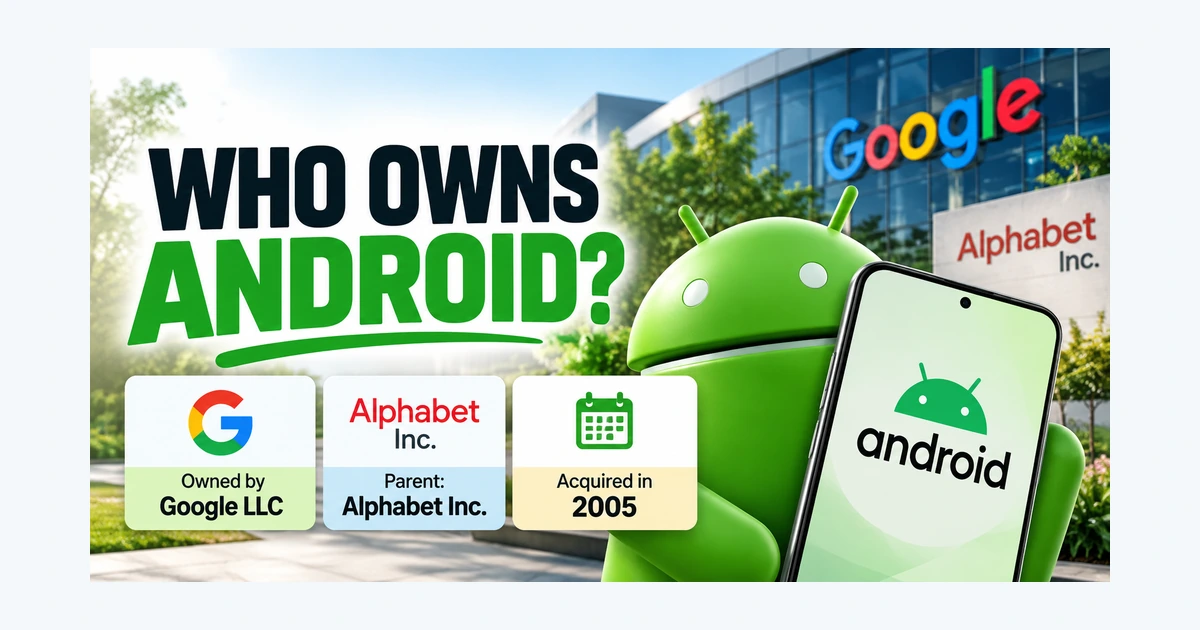
Android is owned by Google LLC, a wholly owned subsidiary of Alphabet Inc., a US company listed on Nasdaq. Alphabet had a market cap of about $4.15 trillion on September 23, 2026. Android is a product, so it has no shareholders, board or valuation of its own.
Android ownership at a glance
Android sits inside Google, so most ownership details below belong to Alphabet.
| Detail | Information |
|---|---|
| Ownership type | Product of a wholly owned subsidiary of a public company |
| Parent company | Google LLC, owned by Alphabet Inc. through XXVI Holdings Inc. |
| Largest shareholders | Larry Page and Sergey Brin (by votes); Vanguard and BlackRock (by Class A shares) |
| Latest market cap | Alphabet: about $4.15 trillion (September 23, 2026) |
| Last acquisition | Google bought Android Inc. in July 2005 for a reported $50 million |
| Founded | October 2003, Palo Alto, California |
| Headquarters | Mountain View, California |
| CEO | Sundar Pichai (Alphabet and Google) |
| Android lead | Sameer Samat, President of the Android Ecosystem |
Who owns Android today?
The ownership chain has three layers: Alphabet Inc. owns XXVI Holdings Inc., which owns Google LLC, and Google LLC develops and owns Android.
Android is not a separate company. It has no board or balance sheet, so no investor can buy a stake in it directly.
Google publishes Android’s core code through the Android Open Source Project under the Apache 2.0 license. Anyone can use that code. Google still holds the Android trademark and decides what goes into each release.
Phone makers such as Samsung, Xiaomi and Motorola build devices on Android but do not own it. Makers that want Google Play and Google’s apps sign licensing agreements with Google.
Who controls Android?
Control of Android runs through Alphabet’s voting shares. Class A stock (GOOGL) carries one vote, Class B carries ten votes and does not trade, and Class C stock (GOOG) carries none.
As of April 6, 2026, co-founders Larry Page and Sergey Brin owned about 89.4% of Class B stock. That gave them 52.7% of total voting power, according to Alphabet’s SEC filings.
Alphabet total voting power, April 2026 (%)
With that majority, the pair can elect every director. Both left executive roles in 2019 and still sit on the ten-member board, which John L. Hennessy chairs.
Sundar Pichai is CEO of Alphabet and Google. Sameer Samat runs Android day to day. The same voting split applies across the company, as this breakdown of Google’s shareholders and voting power shows.
Android’s acquisition and ownership history
Andy Rubin, Rich Miner, Nick Sears and Chris White founded Android Inc. in Palo Alto in October 2003. The startup first planned software for digital cameras, then moved to phones.
Google bought Android Inc. in July 2005. It did not announce a price, and later reports put the deal at about $50 million. Rubin, Miner and White joined Google.
A year later, Google paid $1.65 billion for a video site, and YouTube’s ownership now runs through the same parent chain.
Google formed the Open Handset Alliance in November 2007. The first Android phone, the T-Mobile G1, went on sale in October 2008.
Pichai took charge of Android in March 2013, and Rubin left Google in 2014. When Google reorganized under Alphabet on October 2, 2015, Android stayed inside Google.
Active Android devices reported by Google (billions)
On September 2, 2025, Judge Amit Mehta ruled in the US search antitrust case that Google would not face a forced sale of Android. In March 2026, Samat said a combined Android and ChromeOS platform was on track for a 2026 release.
Who are the biggest investors in Android’s parent company?
Android has no investors of its own. A stake in Android means a stake in Alphabet, where index fund managers hold the largest economic positions and the founders hold the votes.
- Vanguard Capital Management: 436,027,408 Class A shares, 7.48% of the class, per a 2026 SEC filing
- BlackRock: 356,934,964 Class A shares, about 6.1% of the class, per the April 2026 proxy
- Larry Page: 389,051,160 Class B shares, 27.4% of total votes
- Sergey Brin: 358,939,978 Class B shares, 25.3% of total votes
Vanguard split its reporting across separate advisers in January 2026, so its funds now file individually. Alphabet’s self-driving unit works differently, since Waymo has sold minority stakes to outside investors.
Is Android publicly traded?
No. Android has no ticker symbol. Investors who want exposure buy Alphabet Class A shares (GOOGL) or Class C shares (GOOG) on Nasdaq.
Alphabet has not announced any plan to spin off or list Android. The Justice Department sought a possible Android sale in its search case, and the September 2025 ruling left it out of the final judgment.
FAQ
Who founded Android?
Andy Rubin, Rich Miner, Nick Sears and Chris White founded Android Inc. in Palo Alto in October 2003. Google bought the startup in July 2005, and three of the four founders joined Google.
Does Samsung own Android?
No. Samsung is the largest Android phone maker, but Google owns Android. Samsung licenses Google Play and Google’s apps and adds its own One UI software on top of Android.
How much did Google pay for Android?
Google never announced the price. Later reports placed the July 2005 acquisition of Android Inc. at about $50 million, when the startup had no product on the market.
Is Android open source if Google owns it?
Yes. Google releases Android’s core code under the Apache 2.0 license through the Android Open Source Project. Google keeps the Android trademark, sets each release and licenses Google Play separately.
Who runs Android at Google?
Sameer Samat, President of the Android Ecosystem, leads Android. He reports within Google, where Sundar Pichai is CEO of both Google and its parent company, Alphabet.
