Lovable went from zero to $200 million in annual recurring revenue faster than any software company in history. The Swedish “vibe coding” startup reached this milestone in just 12 months, leaving even OpenAI and Cursor in the dust.
This article breaks down Lovable’s explosive revenue growth, business model, pricing strategy, and what the $6.6 billion valuation tells us about the future of AI-powered software development.
Lovable Revenue 2025: The Numbers That Shocked Silicon Valley
As of December 2025, Lovable’s revenue metrics paint an extraordinary growth story:
Current Revenue:
- $200 million ARR (Annual Recurring Revenue) as of November 2025
- $100 million ARR reached in June-July 2025 (8 months from launch)
- Doubled from $100M to $200M ARR in just 4 months
Growth Timeline:
- November 2024: Lovable launches publicly
- December 2024: $1 million ARR
- Early 2025: $4 million ARR in first 4 weeks
- February 2025: $10 million ARR in 2 months
- June-July 2025: $100 million ARR milestone
- November 2025: $200 million ARR
According to CEO Anton Osika, Lovable reached $100 million ARR “faster than OpenAI, Cursor, Wiz, and every other software company in history.” The company doubled that figure to $200 million in just four months, announced at the Slush 2025 conference in Helsinki.
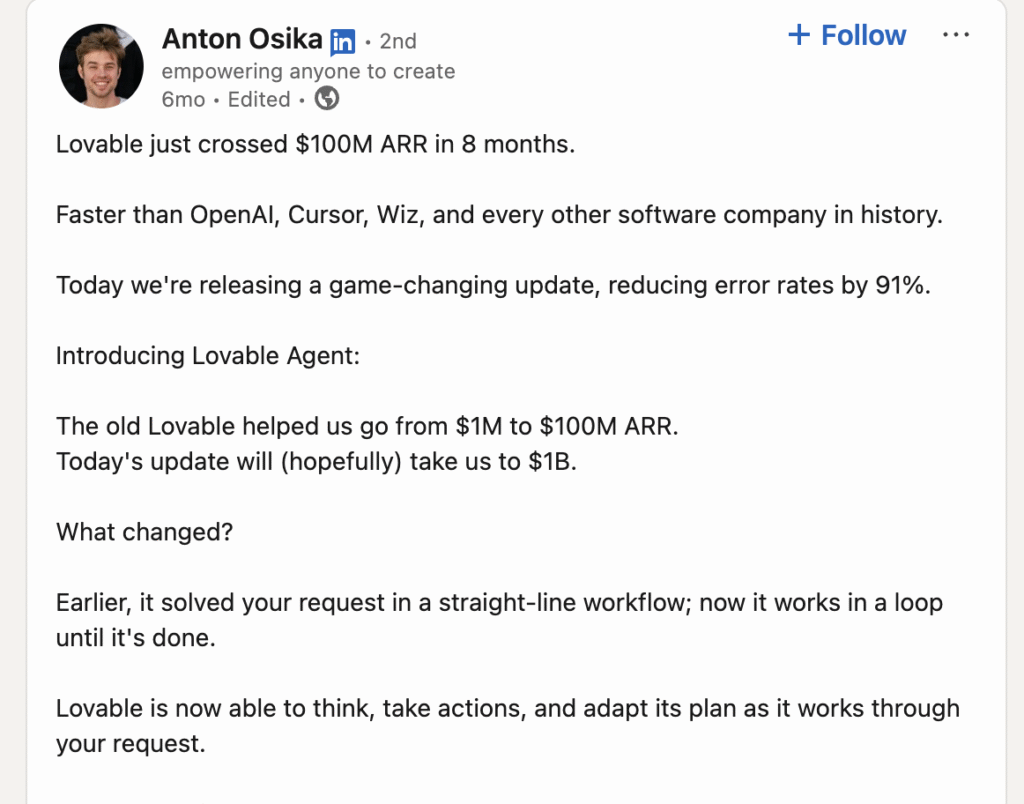
Lovable determines ARR by taking the prior month’s revenue, multiplying it by 12, and annualizing the result—a standard SaaS metric that helps investors understand growth trajectory.
How Lovable Makes Money: The Business Model Breakdown
Lovable operates on a subscription-based business model with multiple revenue streams. Here’s exactly how the company generates $200 million annually:
Subscription Tiers
Lovable offers four main pricing tiers as of February 2026:
Free Plan ($0/month)
- 5 daily credits (use-it-or-lose-it)
- Public projects only
- Access to core vibe coding features
- Lovable badge on apps
- Up to 5 lovable.app domains
Pro Plan ($25/month or $252/year)
- 100 monthly credits (roll over with active subscription)
- 5 daily credits
- Unlimited private projects
- Custom domains
- User roles and permissions
- Remove Lovable badge
- Code editing capabilities
Business Plan ($50/month or $504/year)
- 200 monthly credits
- All Pro features
- Single Sign-On (SSO)
- Personal projects
- Design templates
- Opt-out of data training for AI models
- Advanced security controls
Enterprise Plan (Custom pricing)
- Custom credit allowances (up to 10,000+ credits/month)
- Dedicated account management
- Priority support and onboarding
- Advanced security and compliance
- Custom integrations
- Group-based access controls
- Service Level Agreements (SLAs)
Credit System Economics
Lovable uses a credit-based system where each AI interaction costs credits based on complexity:
- Simple requests: 0.5 credits (e.g., changing button styling)
- Standard requests: 1 credit (most interactions)
- Complex requests: 2+ credits (building entire app structures)
- Chat mode (no code edits): 1 credit per message
This creates predictable revenue per user. If a Pro subscriber ($25/month) uses their 100 credits plus 150 daily credits (5 × 30 days), that’s 250 total interactions per month at an effective cost of $0.10 per credit.
Additional Revenue Streams
Lovable Cloud (Backend-as-a-Service): Every workspace gets a $25/month free allowance for cloud hosting and $1/month for in-app AI features. Beyond that, users pay usage-based fees for:
- Database storage
- File storage
- Serverless function executions
- API calls
This creates an additional revenue stream beyond subscriptions, especially for users running production applications that scale.
Credit Add-Ons: Users can purchase additional credits beyond their monthly allocation. Pro and Business users can buy credit top-ups when they run out, creating variable revenue on top of base subscriptions.
Custom Domains: While included in Pro and above, this feature drives conversions from free to paid tiers.
The Path to $200M ARR: Growth Strategy Analysis
Lovable’s revenue acceleration didn’t happen by accident. Here’s the strategic playbook that generated $200 million in ARR:
1. Product-Led Growth From Day One
Lovable launched with a generous free plan that lets anyone build apps instantly. This created viral loops:
- Users build apps in minutes
- Share them on social media (Twitter/X, LinkedIn, Reddit)
- Others see the demos and sign up
- Cycle repeats
The company reports 100,000+ new projects created daily on the platform. Even if only 1% of users eventually convert to paid plans, that’s massive revenue potential.
2. Enterprise Land-and-Expand
More than 50% of Fortune 500 companies use Lovable, according to company statements. The strategy:
Land: Individual developers at large companies discover Lovable and build prototypes
Expand: Success stories spread internally, leading to department-wide adoption
Enterprise Deal: Companies negotiate multi-million dollar contracts for organization-wide access
Osika confirmed in November 2025: “If you look at people who have accounts from enterprises, it’s like half [of customers]. Most of it is coming from an individual who starts using Lovable and then brings it into the company. And then, in some cases, it’s growing into a larger contract across the entire company and turning into multimillion-dollar deals.”
3. Founder-Led Startup Ecosystem
Lovable positioned itself as the platform for non-technical founders. Real examples shared by the company:
- Lumoo: AI fashion platform reached €800k ARR in 9 months
- ShiftNex: Healthcare staffing solution hit €1M ARR in 5 months
- Q Group: Brazilian EdTech generated €3M revenue in 48 hours after launch
These success stories drive more founders to Lovable, creating a self-reinforcing growth engine.
4. Customer Success Driving Retention
Lovable reports over 100% net dollar retention, meaning existing customers spend more over time. This happens through:
- Users starting with Pro, upgrading to Business
- Adding more team members
- Expanding credit allowances
- Building multiple projects that scale to production
High retention means Lovable doesn’t just acquire revenue—it compounds it monthly.
5. The Network Effect
Apps built with Lovable have received over 500 million combined visits in the last 6 months, according to December 2025 data. Each successful app becomes a showcase for the platform’s capabilities, driving organic growth.
More than 25 million projects were created on Lovable in its first year of operation.
Lovable Valuation: From $1.8B to $6.6B in 5 Months
Lovable’s valuation trajectory is just as remarkable as its revenue growth:
Funding History:
October 2023: $8 million seed round led by Hummingbird VC
Valuation: Not disclosed
July 2025: $200 million Series A led by Accel
Valuation: $1.8 billion
Other investors: Creandum, Klarna founder Sebastian Siemiatkowski, ElevenLabs founder Mati Staniszewski, Synthesia founder Victor Riparbelli
December 2025: $330 million Series B
Valuation: $6.6 billion
Lead investors: CapitalG (Alphabet/Google) and Menlo Ventures
Other investors: Nvidia Ventures (NVentures), Salesforce Ventures, Databricks Ventures, HubSpot Ventures, Atlassian Ventures, Deutsche Telekom (T.Capital), Khosla Ventures, DST Global, EQT Growth, Kinship Ventures (backed by actress Gwyneth Paltrow), plus returning investors Accel, Creandum, and Evantic
Total funding raised in 2025: Over $500 million
The $6.6 billion valuation at $200 million ARR gives Lovable a revenue multiple of 33x ARR. For comparison:
- Traditional SaaS companies: 5-10x ARR
- High-growth SaaS: 15-20x ARR
- Lovable: 33x ARR
Why such a high multiple? Investors are betting on:
- Rapid growth continuation (100%+ YoY)
- Massive TAM (total addressable market) in AI coding
- Strong retention metrics (>100% NDR)
- Enterprise traction (Fortune 500 adoption)
- Platform network effects (viral growth mechanics)
Who Founded Lovable? The Story Behind the Revenue Machine
Lovable was founded in 2023 by two Swedish entrepreneurs who are now billionaires:
Anton Osika (Co-Founder & CEO, 35 years old)
Background:
- Former particle physicist at CERN
- First employee and engineer at Sana Labs (Swedish AI unicorn that raised $80M+)
- Co-founded Depict.ai in 2019 (e-commerce AI company that raised $20M from Tiger Global, EQT Ventures, Y Combinator)
- Created GPT Engineer, an open-source tool that became one of the most-starred AI repos on GitHub (50k+ stars)
Current net worth: Approximately $1.6 billion (owns ~24% of Lovable)
Osika describes Lovable’s mission as building “the last piece of software”—a platform where anyone can create applications through natural language, eliminating the need for traditional coding.
Fabian Hedin (Co-Founder & CTO, 26 years old)
Background:
- Former colleague of Osika at Depict.ai
- Joined Lovable in October 2023 as co-founder and CTO
- One of Europe’s youngest self-made billionaires
Current net worth: Approximately $1.6 billion (owns ~24% of Lovable)
Both founders have pledged to donate 50% of their earnings from any future exit to charity, specifically focused on ensuring humanity’s transition to superintelligent AI benefits all humans.
“Me and Fabian have pledged a very large part of the value that we build up from Lovable will go to ensuring that humanity’s transition to super intelligent AI goes well, and it is good for the humans that live through it,” Osika told Forbes in July 2025.
The Origin Story
Lovable began as GPT Engineer, an open-source project Osika created that went viral among developers. He quickly realized the bigger opportunity wasn’t serving the 1% who can code—it was empowering the 99% who can’t.
In a 6 AM wake-up call, Osika biked to his co-founder’s apartment with the vision: “We’re going to reimagine how you build software.”
They launched “GPT Engineer App” in late 2023, which was renamed to “Lovable” in December 2024. The product publicly launched in November 2024 and hit $1 million ARR within weeks.
What Is Vibe Coding? The Category Lovable Created
“Vibe coding” is the term Lovable popularized to describe building software through natural language prompts instead of writing code. The concept:
Traditional coding:
- Write code syntax
- Debug errors
- Handle deployment
- Manage infrastructure
Vibe coding:
- Describe what you want in plain English
- AI generates working code
- Instant preview and deployment
- Infrastructure handled automatically
Lovable’s platform uses large language models from OpenAI and Anthropic, adding proprietary layers to improve reliability and usability. Users get a blank canvas where they can create products that “previously required entire teams, back-end engineers, front-end engineers,” according to Osika.
The platform generates React + Tailwind CSS front-ends, provisions back-end code, orchestrates databases, and handles cloud deployment—all from text descriptions.
Customer Base: Who Pays for Lovable?
Lovable serves three distinct customer segments:
Individual Creators & Non-Technical Founders
Examples:
- An 11-year-old in Lisbon built a Facebook clone for his school
- A Swedish duo making $700,000 annually from a startup launched 7 months ago on Lovable
- Thousands of makers building side projects and MVPs
Revenue impact: High volume, lower ARPU (Average Revenue Per User), typically on Pro plans ($25/month)
Small Teams & Startups
Examples:
- Lumoo (AI fashion platform): €800k ARR in 9 months
- ShiftNex (healthcare staffing): €1M ARR in 5 months
- Q Group (Brazilian EdTech): €3M revenue in 48 hours
Revenue impact: Medium volume, medium ARPU, typically on Business plans ($50/month) or custom credit packages
Enterprise Customers
Named customers:
- Klarna
- Uber
- Zendesk
- Over 50% of Fortune 500 companies
Revenue impact: Low volume, extremely high ARPU, custom Enterprise contracts worth millions annually
The enterprise segment likely drives the majority of Lovable’s $200M ARR despite representing a smaller percentage of total users.
User Metrics: The Scale Behind $200M Revenue
As of December 2025, Lovable’s user base and activity metrics:
User Growth:
- 8 million users (approaching this milestone as of November 2025)
- Up from 2.3 million users in July 2025
- 3.5x growth in 4 months
Daily Activity:
- 100,000+ new projects created every day
- 25+ million projects created in first year
Traffic:
- Apps built with Lovable received 500+ million combined visits in last 6 months
Retention:
- Over 100% net dollar retention (customers spend more over time)
- Strong engagement despite some traffic decline noted by Barclays analysts in September 2025
The Barclays research showed Lovable’s traffic was down 40% from peak as of September, raising questions about whether vibe coding had peaked. However, Osika maintains retention remains strong, and the November ARR doubling suggests the platform’s value proposition is intact.
Competition: How Lovable Stacks Up in Vibe Coding Revenue
The vibe coding market exploded in 2025, with multiple players raising massive funding rounds:
Cursor (Anysphere)
- Valuation: $29.3 billion (November 2025)
- Funding: $2.3 billion Series B
- Estimated ARR: Not disclosed, but significantly higher than Lovable based on valuation
- Focus: AI-powered IDE for professional developers
Replit
- Valuation: $3 billion (September 2025)
- Funding: $250 million
- Estimated ARR: Not disclosed
- Focus: Browser-based coding environment with AI assistance
Vercel v0
- Valuation: $9.3 billion (September 2025)
- Funding: $300 million
- Revenue: Not disclosed
- Focus: AI-powered UI component generation
Lovable’s Competitive Position:
At $6.6 billion valuation and $200M ARR, Lovable sits in the middle of the pack by valuation but leads in revenue transparency and growth rate disclosure. Key differentiators:
- Full no-code approach: Unlike Cursor (developer-focused) or v0 (component-focused), Lovable targets non-technical users building complete applications
- European leadership: Lovable is Europe’s most valuable vibe coding startup, competing primarily with U.S.-based rivals
- Enterprise traction: Fortune 500 adoption gives Lovable credibility and revenue stability
- Viral growth mechanics: Daily project creation numbers exceed competitors’ disclosed metrics
Challenges and Controversies
Despite explosive growth, Lovable has faced some challenges:
Security Incidents
In March 2025, a Replit employee discovered a security vulnerability in Lovable-built websites. Many sites didn’t properly configure access controls for their Supabase databases, making contents public.
Lovable responded by automatically checking websites for access controls, though these scans don’t determine if controls are correctly configured.
VAT Compliance Issues
In November 2025, Lovable was called out for not paying VAT (Value Added Tax) in the European Union. Osika confirmed this was true in a LinkedIn post, saying the company would remedy the situation. He shut down comments suggesting taxes are why the EU isn’t good for high-growth startups.
Traffic Decline Questions
Barclays research in summer 2025 showed traffic to Lovable (and competitor v0) declined 40% from peak. Google Trends data supported this finding.
However, Lovable’s ARR doubling from $100M to $200M between July and November suggests paying customers remain highly engaged, even if free-tier experimentation declined.
Sustainability of Vibe Coding
Critics question whether AI-generated code quality can match human developers for production applications, especially in regulated industries or mission-critical systems.
Osika’s response: “If you are doing something that is life and death I would get a human software engineer to review the security aspect of it. But if it is not life and death, you are taking similar risks to hiring a human software engineer.”
Future Plans: Where Lovable’s Revenue Goes From Here
Lovable announced specific plans for its $330 million Series B funding:
Product Development
Deeper third-party integrations: Connecting Lovable apps with more external services and APIs
Enhanced enterprise features: Expanding collaboration tools, governance capabilities, and security controls
Platform infrastructure: Building out databases, payments, and hosting features to support full-fledged production applications
Agent mode improvements: Continuing to enhance AI capabilities for more complex development tasks
Geographic Expansion
Lovable is opening offices in Boston and San Francisco to tap into U.S. talent and markets while maintaining its Stockholm headquarters.
Revenue Targets
While Lovable hasn’t disclosed official 2026 revenue targets, investor expectations based on the $6.6B valuation likely assume:
- Maintaining 100%+ growth rate would put 2026 ARR at $400M+
- Path to $1B ARR within 2-3 years
- Potential IPO at $10B+ valuation if growth continues
What Lovable’s Success Means for the Industry
Lovable’s $200 million ARR milestone signals fundamental shifts in software development:
1. No-Code Goes Mainstream
Lovable proves non-technical users can build production-quality applications. This expands the software creator base from millions to billions.
2. AI Coding Becomes a Category
The combined valuations of Lovable, Cursor, Replit, and Vercel exceed $48 billion. Vibe coding isn’t a fad—it’s a new software category with massive venture backing.
3. European AI Wins
Lovable demonstrates Europe can build globally competitive AI companies. The Stockholm-to-$6.6B-valuation story challenges Silicon Valley dominance narratives.
4. Speed Matters More Than Ever
Lovable’s 12-month journey to $200M ARR shows AI-native companies can achieve unprecedented growth velocity. Traditional SaaS timelines no longer apply.
5. Enterprise AI Adoption Accelerates
Fortune 500 companies adopting Lovable en masse suggests enterprises are moving faster on AI tools than many predicted.
Key Takeaways on Lovable Revenue
Here’s what matters about Lovable’s revenue story:
1. Fastest software growth in history – $200M ARR in 12 months beats OpenAI, Cursor, and every other software company’s early revenue trajectory
2. Credit-based model drives predictable revenue – Simple pricing ($25-$50/month base plans) with usage-based credits creates scalable economics
3. Enterprise drives the big numbers – Individual creators generate volume, but Fortune 500 contracts likely drive majority of $200M ARR
4. 100%+ net dollar retention – Customers spending more over time means compounding revenue growth without equivalent customer acquisition costs
5. Viral mechanics built-in – 100,000 daily projects and 500M+ app visits create organic growth loops that reduce marketing spend
6. $6.6B valuation reflects growth expectations – At 33x ARR multiple, investors expect Lovable to maintain 100%+ annual growth for years
7. Swedish founders now billionaires – Osika and Hedin each worth ~$1.6B, pledging 50% to AI safety causes
8. Vibe coding validated as category – $48B+ combined valuations across competitors prove the market is real and massive
What’s Next for Lovable?
As Lovable enters 2026 with $200 million in ARR and $330 million in fresh funding, the company faces a critical inflection point.
Can it maintain 100%+ growth to reach $400M+ ARR by year-end? Will enterprise expansion justify the 33x revenue multiple? Can the team scale from 15 people to hundreds while maintaining product quality?
The answers will determine whether Lovable becomes the next $100B software company or joins the list of AI startups that grew too fast to sustain.
One thing is certain: Lovable has already rewritten the playbook for SaaS revenue velocity. $200 million in 12 months isn’t just impressive—it’s historic.