
OpenAI went from a research lab that barely did M&A to the most acquisitive AI company in the world in the space of two years. It made one acquisition in 2023, two in 2024, and then something shifted. In 2025, it completed eight acquisitions including the $6.5 billion purchase of Jony Ive’s hardware startup io. By March 2026, it had already matched nearly all of 2025’s deal count with six more purchases. The company has now confirmed 17 acquisitions since 2023. Below is a full breakdown of every confirmed deal, plus the Windsurf saga, the most dramatic M&A collapse in recent AI history.
Key Takeaways
- OpenAI has completed 17 confirmed acquisitions between 2023 and May 2026
- The io acquisition for $6.5 billion is the largest in OpenAI’s history and its first move into consumer hardware
- The Windsurf deal agreed in May 2025 for $3 billion collapsed in July 2025 over a Microsoft IP dispute; Cognition ultimately acquired Windsurf instead
- OpenAI’s 2026 acquisitions cover developer tools (Astral, Promptfoo), healthcare (Torch), AI agents (OpenClaw), and consulting (Convogo)
- Anthropic by contrast has made just three known acquisitions total, preferring compute infrastructure investment
- Eight of OpenAI’s 17 acquisitions feature open-source components, reflecting a deliberate developer ecosystem strategy
- OpenAI is projected to burn $17 billion in 2026, making its M&A pace a key question for investors ahead of its planned IPO
The Windsurf Saga (The Deal That Never Closed)
Before the confirmed deals, it is worth covering Windsurf separately because it is the most talked-about OpenAI M&A story of 2025 and it ended with OpenAI getting nothing.
In May 2025, OpenAI agreed to acquire Windsurf, an AI coding tool formerly known as Codeium, for approximately $3 billion. It would have been OpenAI’s largest acquisition at the time. The deal never closed.
Microsoft, OpenAI’s largest backer, blocked it. Under their partnership agreement, Microsoft has extensive rights to any technology OpenAI develops or acquires. Microsoft expected those rights to extend to Windsurf’s IP. OpenAI refused, not wanting to hand a direct competitor to its own coding tools over to Microsoft’s GitHub Copilot division. The exclusivity period expired, and Windsurf was free to go elsewhere.
What followed was one of the most chaotic 72-hour periods in AI M&A history. Google stepped in and hired Windsurf’s CEO Varun Mohan, co-founder Douglas Chen, and key R&D staff for Google DeepMind in a $2.4 billion licensing and talent deal. Days later, AI startup Cognition best known for its Devin autonomous coding agent, acquired the remaining Windsurf business, including its IP, product, brand, $82 million in ARR, 350+ enterprise customers, and its engineering and go-to-market teams, for undisclosed terms.
OpenAI ended up with nothing from Windsurf. It is a useful reminder that announced M&A deals in AI, especially those involving Microsoft’s IP arrangements, do not always close.
Confirmed Acquisitions: The Full List
1. io (Jony Ive’s Hardware Startup) — $6.5 Billion
Announced: May 21, 2025 | Closed: July 9, 2025 | Structure: All-stock
The largest acquisition in OpenAI’s history. io was a hardware startup founded by Jony Ive, the former Apple chief design officer behind the iPhone, iPad, iPod, and MacBook Air. OpenAI had already acquired a 23% stake in io at the end of 2024 before buying the rest outright for $6.5 billion in an all-stock deal.
The goal is to build a new generation of AI devices designed to move users beyond phones and laptops. Sam Altman and Ive have been collaborating for two years on form factors including AI headphones, cameras, and ambient devices. As part of the deal, Ive and his design studio LoveFrom remained independent but took on deep creative and design responsibilities across OpenAI. Co-founders Scott Cannon, Evans Hankey, and Tang Tan, along with roughly 55 engineers and designers, joined OpenAI directly.
2. Statsig — Reported $1.1 Billion
Acquired: September 2025
Statsig is an enterprise product analytics and A/B testing platform. OpenAI acquired it in a reported billion-dollar-scale deal, giving it the tooling to run rigorous product experiments across ChatGPT and its API products as it scales to hundreds of millions of users.
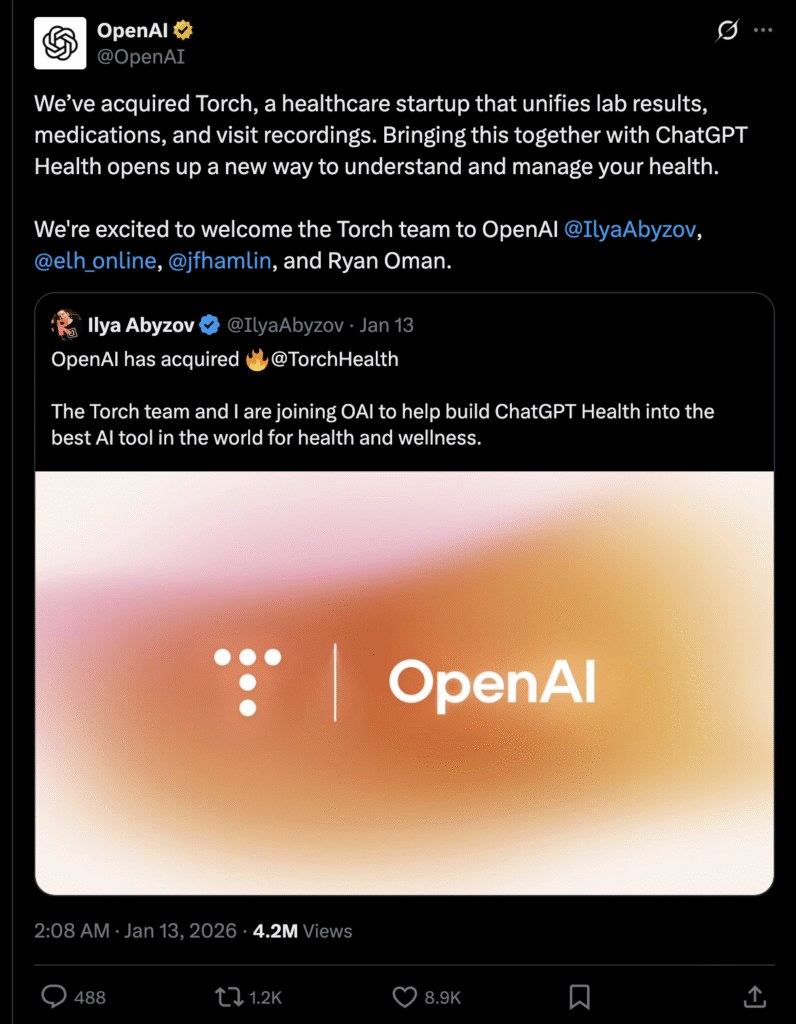
3. Torch Health — ~$100 Million
Acquired: January 2026
An AI-powered healthcare app that unifies scattered medical records into a single view for patients and providers. OpenAI acquired it primarily in equity for approximately $100 million. The deal supports OpenAI’s ChatGPT Health initiative and is its first move into regulated consumer health data.
4. Convogo — Terms Undisclosed
Acquired: January 2026
A consulting firm specialising in custom AI solutions, predictive analytics, and GenAI strategy. Primarily an acqui-hire bringing enterprise AI deployment expertise to OpenAI ahead of its IPO push.
5. Crixet (Now OpenAI Prism) — Terms Undisclosed
Acquired: January 2026
A small startup popular in the scientific community for LaTeX editing and AI-assisted diagram and formula generation in academic documents. OpenAI rebranded it as OpenAI Prism, positioning it as a tool for researchers using ChatGPT for scientific work.
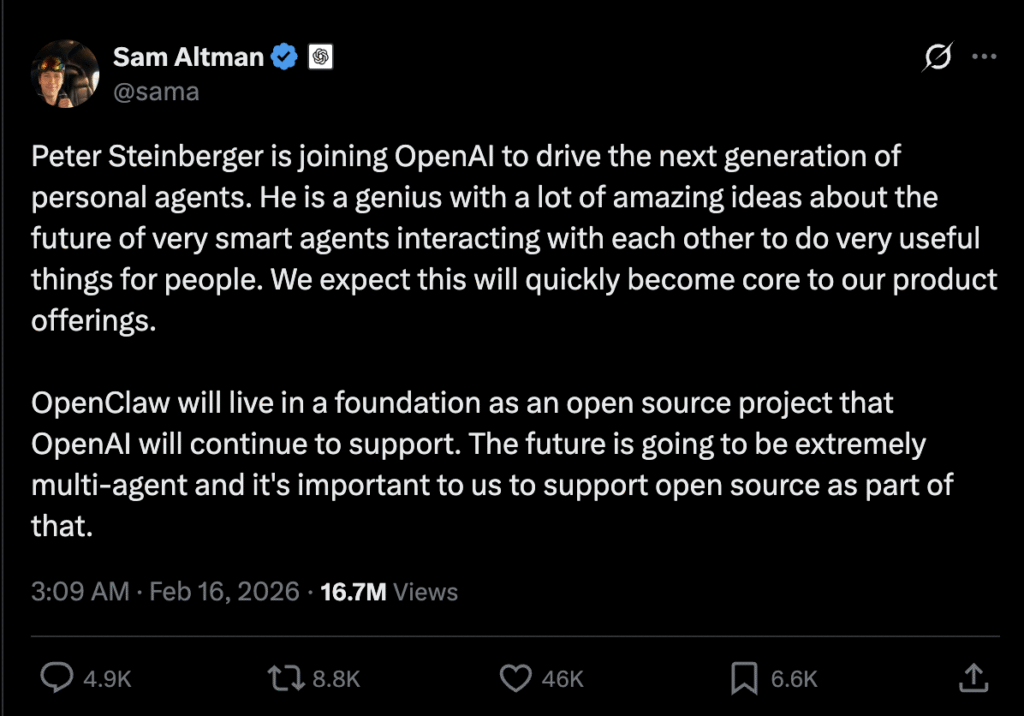
6. OpenClaw — Acqui-hire
Acquired: February 2026
An open-source AI agent project. OpenAI acquired the creator via acqui-hire, bringing the developer onto the team as it builds out its Agents platform.
7. Promptfoo — Terms Undisclosed
Acquired: March 2026
An open-source tool for testing AI applications, specifically for detecting security vulnerabilities, hallucinations, and failure modes in LLM-powered products. The acquisition supports OpenAI’s push into AI security and reliability tooling for enterprise customers.
8. Astral — Terms Undisclosed
Announced: March 19, 2026
Astral builds some of the most widely used open-source Python developer tools, including Ruff (a fast linter) and uv (a package manager). Both are deeply embedded in professional Python workflows globally. OpenAI acquired Astral to strengthen its Codex team and compete more aggressively with GitHub Copilot and Claude Code for developer mindshare.
Earlier Deals (2024 and 2025)
- Rockset (2024): A search and analytics database platform. Terms undisclosed.
- Multi (2024): A video collaboration platform. Terms undisclosed.
- Global Illumination (2023): A creative tools and digital experiences company. OpenAI’s first-ever acquisition. Terms undisclosed.
- Context.ai (2025): An analytics and evaluation platform for LLM behaviour. Acqui-hire.
- Neptune (December 2025): Dashboard and debugging tools for large-scale model training runs.
The Pattern Behind the Deals
Looking across all 17 acquisitions, four clear strategic lanes emerge.
Consumer hardware. io is the anchor. OpenAI is betting the next computing platform will be built specifically for AI interaction, not adapted from smartphones or laptops.
Developer ecosystem lock-in. Astral, Promptfoo, and the attempted Windsurf deal all point to the same strategy: embed OpenAI’s tools inside developer workflows so deeply that switching becomes painful. Eight of 17 acquisitions feature open-source components, which is a deliberate way to build developer loyalty before monetising.
Healthcare and regulated verticals. Torch Health is the opening move in a sector where AI has significant potential but where trust and data compliance matter enormously.
Enterprise analytics and infrastructure. Statsig, Context.ai, and Neptune strengthen OpenAI’s ability to run its own products with the same rigour it sells to enterprise customers.
One broader point worth making: Anthropic has made just three known acquisitions total across the same period. Its strategy is the opposite of OpenAI’s fewer deals, more investment in compute infrastructure, including a partnership with Google and Broadcom for 3.5 gigawatts of TPU capacity announced in April 2026. Which approach proves more effective in building an enduring AI platform is one of the most interesting competitive questions heading into 2027.
