
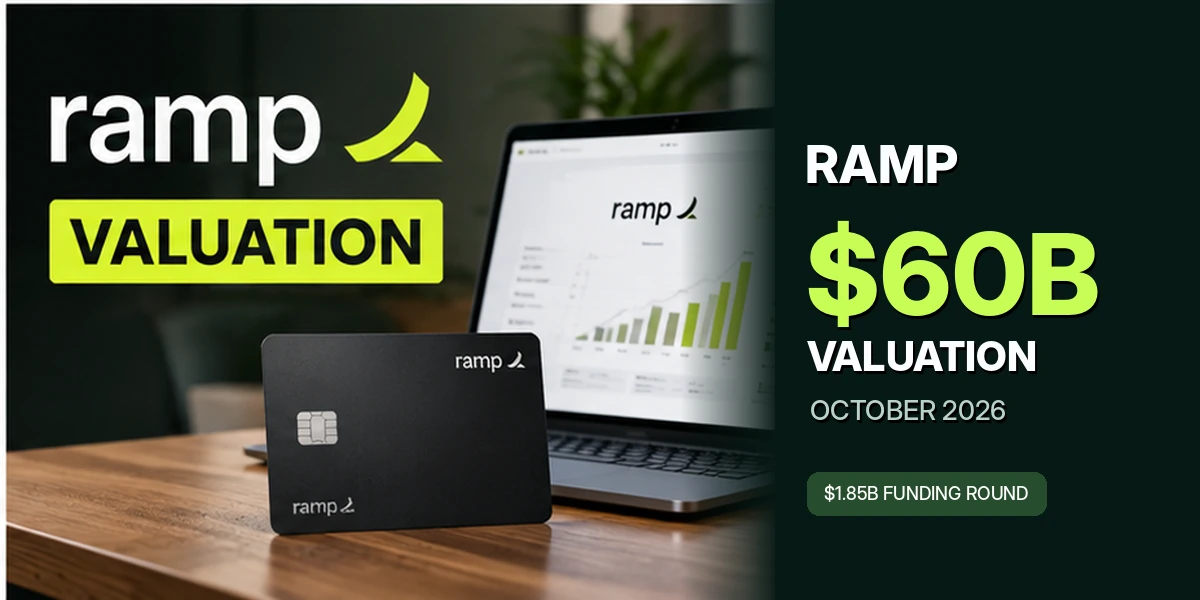
Ramp’s valuation reached $60 billion in October 2026. The New York fintech company announced a $1.85 billion primary financing round led by Dragoneer Investment Group on October 15, 2026.
The round came four months after Ramp raised $750 million at a $44 billion valuation. At the time of the announcement, Ramp reported more than $2 billion in annualized revenue and positive cash flow.
The figures below cover each Ramp funding round, the revenue behind the price, and how the company compares with its closest rival.
Ramp valuation in 2026: the $60 billion round
Dragoneer led the October 2026 round. Sacra lists Thrive Capital, Founders Fund, Sands Capital and Avenir as co-leads.
Bloomberg first reported the deal on October 9, 2026, citing people familiar with the matter. Its sources described the $60 billion figure as a pre-money valuation, meaning it excludes the $1.85 billion of new capital.
Ramp has raised about $5 billion in total funding, according to TechCrunch. That total includes debt facilities as well as equity rounds.
Ramp’s raise can be compared with other late-stage deals in this daily tracker of startup funding rounds.
Key numbers behind the latest Ramp valuation
Ramp’s October 2026 announcement listed the following metrics:
- Annualized revenue above $2 billion, with positive cash flow
- More than 85,000 business customers
- Over $275 billion in annualized purchase volume, up 175% year over year
- A 113% year-over-year rise in customers generating more than $100,000 in revenue
At $60 billion, Ramp trades at roughly 30 times its annualized revenue, based on Sacra’s estimate.
Ramp valuation history from 2021 to 2026
Ramp was founded in March 2019 by Eric Glyman, Karim Atiyeh and Gene Lee. Glyman and Atiyeh had previously sold their price-tracking startup Paribus to Capital One in 2016.
The company launched its corporate card in February 2020. It reached unicorn status 14 months later.
Ramp funding rounds and valuations
| Date | Round | Amount raised | Valuation | Lead investor(s) |
|---|---|---|---|---|
| Apr 2021 | Series B | $115M | $1.6B | D1 Capital |
| Aug 2021 | Series C | $300M | $3.9B | Founders Fund |
| Mar 2022 | Series C extension | $200M | $8.1B | Founders Fund |
| Aug 2023 | Series D | $300M | $5.8B | Thrive Capital |
| Apr 2024 | Series D extension | $150M | $7.65B | Khosla Ventures, Founders Fund |
| Mar 2025 | Secondary sale | $150M | $13B | Not disclosed |
| Jun 2025 | Series E | $200M | $16B | Founders Fund |
| Jul 2025 | Series E-2 | $500M | $22.5B | ICONIQ |
| Nov 2025 | Primary round and tender | $300M | $32B | Lightspeed Venture Partners |
| Jun 2026 | Series F | $750M | $44B | ICONIQ, GIC, Ontario Teachers’ |
| Oct 2026 | Primary round | $1.85B | $60B | Dragoneer Investment Group |
The 2023 down round
Ramp’s valuation peaked at $8.1 billion in March 2022. In August 2023, the company raised $300 million at $5.8 billion, a 28% cut.
The markdown followed a wider repricing of fintech stocks after interest rates rose. Ramp recovered most of the gap in April 2024 with a $150 million extension at $7.65 billion.
Four valuation increases in 2025
Ramp moved from $13 billion in March 2025 to $32 billion by November 2025. The June Series E and July Series E-2 closed about 45 days apart.
The November round, led by Lightspeed, doubled the valuation set in the Series E. It also included an employee tender offer, which let staff turn part of their startup equity and stock options into cash.
What drives Ramp’s valuation: revenue growth
Ramp’s valuation tracks its revenue run rate closely. The company reached $100 million in annualized revenue in early 2022.
TechCrunch reported in March 2025 that Ramp had more than doubled its annualized revenue to $700 million. Ramp said it crossed $1 billion in September 2025.
By June 2026, Bloomberg put the run rate above $1.5 billion. Four months later, Ramp reported more than $2 billion.
Customer growth at Ramp
Ramp served about 25,000 businesses in 2024. The count reached 50,000 at the start of 2026 and 70,000 by June.
The October 2026 figure stands at more than 85,000. Most customers now use two or more Ramp products, and a quarter use three or more.
How Ramp makes money
Ramp earns most of its revenue from interchange fees on its corporate card. Each time a customer’s employee pays with a Ramp card, Ramp collects a share of the transaction fee.
Software subscriptions add a second stream. Sacra lists Ramp Plus at $15 per user per month plus a platform fee, while Enterprise plans use custom annual pricing.
Ramp’s product lineup
Ramp started with corporate cards and expense reports. It now sells bill payments, procurement, vendor management, travel booking and accounting automation.
The company has added AI agents across these products. In 2026, it launched tools that track and cap company spending on AI services.
Ramp’s $750 million Series F closed in June 2026, the same quarter as the biggest AI funding rounds of Q2 2026, led by Anthropic’s $65 billion Series H.
Ramp vs Brex: how the valuations compare
Brex was Ramp’s closest rival in the startup corporate card market. Its valuation peaked at $12.3 billion in January 2022.
Capital One agreed to buy Brex for $5.15 billion in cash and stock on January 22, 2026. The price sat 58% below Brex’s peak valuation.
| Metric | Ramp | Brex |
|---|---|---|
| Founded | 2019 | 2017 |
| Peak private valuation | $60B (Oct 2026) | $12.3B (Jan 2022) |
| Latest price | $60B | $5.15B (Capital One deal) |
| Customers | 85,000+ | About 25,000 to 35,000 |
| Status | Private, independent | Being acquired by Capital One |
Ramp also competes with Rippling, which has added corporate cards, expense management and bill pay to its HR software. Expensify and Mercury overlap with parts of Ramp’s product set.
Ramp IPO plans and what comes next
Ramp has not filed for an initial public offering. CEO Eric Glyman told Bloomberg in June 2026 that the company plans to go public eventually, though he gave no date.
Ramp’s recent rounds, along with employee tender offers, give investors and staff ways to sell shares without a listing. Positive cash flow also reduces the company’s need for new outside capital.
The 30x revenue multiple sets a high bar. Sacra notes that slower growth or pricing pressure would shift investor focus to margins and the success of Ramp’s newer products.
Conclusion
Ramp’s valuation reached $60 billion in October 2026, up from $1.6 billion in April 2021. The company recovered from a 2023 down round and raised its valuation more than sevenfold between April 2024 and October 2026.
Revenue growth explains most of the increase. Ramp passed $2 billion in annualized revenue with positive cash flow and more than 85,000 customers. Its next valuation test will come from whether that growth rate holds at a 30x revenue multiple, and from the timing of any public listing.
FAQ
What is Ramp’s current valuation?
Ramp is valued at $60 billion after raising $1.85 billion in October 2026. Dragoneer Investment Group led the round. The previous valuation was $44 billion, set in June 2026.
How much money has Ramp raised?
Ramp has raised about $5 billion in total funding across equity rounds and debt facilities since its founding in 2019, according to TechCrunch.
What is Ramp’s annual revenue?
Ramp reported more than $2 billion in annualized revenue in October 2026, with positive cash flow. The figure was above $1 billion in September 2025 and $700 million in March 2025.
Is Ramp a public company?
No. Ramp is privately held. CEO Eric Glyman has said the company intends to go public eventually, but Ramp has not filed for an IPO or announced a timeline.
Who founded Ramp?
Eric Glyman, Karim Atiyeh and Gene Lee founded Ramp in New York in March 2019. Glyman is CEO and Atiyeh is CTO. Glyman and Atiyeh earlier sold Paribus to Capital One.
