

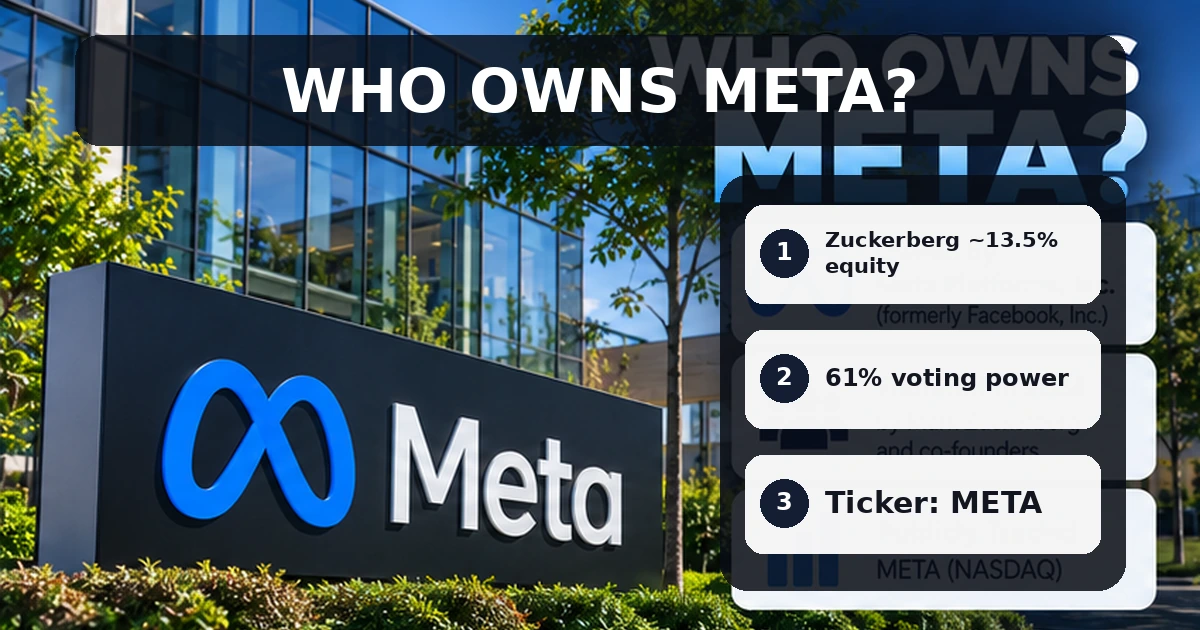
Mark Zuckerberg is the largest and controlling shareholder of Meta Platforms, Inc., a publicly traded American company on Nasdaq with a market capitalization of about $1.39 trillion as of August 20, 2026. He holds roughly 13.5% of outstanding shares and 61% of the voting power. No parent company owns Meta.
Meta ownership at a glance
The figures below come from Meta’s 2026 proxy statement, filed April 16, 2026, and from Schedule 13G filings by institutional holders. Meta qualifies as a “controlled company” under Nasdaq rules because one shareholder holds a majority of the voting power.
| Ownership type | Public company, dual-class structure, founder-controlled |
|---|---|
| Parent company | None — independent |
| Largest shareholders | Mark Zuckerberg, Vanguard, BlackRock, FMR (Fidelity), State Street |
| Latest market cap | $1.39 trillion (August 20, 2026) |
| Last funding round or acquisition | IPO on Nasdaq, May 18, 2012 |
| Founded | February 2004, as TheFacebook |
| Headquarters | Menlo Park, California, United States |
| CEO | Mark Zuckerberg |
Who owns Meta today?
Meta had 2,196,045,588 Class A shares and 342,377,716 Class B shares outstanding as of April 1, 2026, the record date in its 2026 proxy statement.
Zuckerberg owns nearly all of the Class B stock. Against the combined share count, that works out to roughly 13.5% of the company by economic ownership.
He holds most of those shares indirectly, through CZI Holdings, several CZ Holdings entities and CZ Management, all beneficially owned by him. A 2006 trust sits above CZI, and Zuckerberg is its sole trustee, so he retains sole voting and investment power over the securities.
The rest of the company sits with institutional and retail holders of Class A stock. Other executives own Class A shares only: Susan Li, Christopher Cox, Javier Olivan and Andrew Bosworth each held well under 1% at the last disclosure.
Who controls Meta?
Control and economic ownership are not the same thing here. Class A shares carry one vote each. Class B shares carry ten. That ratio gives Zuckerberg 61% of the total voting power on a stake of about one-seventh of the equity.
Shareholders filed a proposal in 2026 asking Meta to collapse the dual-class structure. The board recommended a vote against it, and all ten shareholder proposals failed at the May 27, 2026 annual meeting. Zuckerberg’s votes alone are enough to decide the outcome.
The board has twelve directors as of the 2026 annual meeting, eleven of them independent. Robert Kimmitt serves as lead independent director. Meta’s charter also triggers a classified board if Class B stock ever drops below a majority of combined voting power.
Voting power vs economic stake in Meta (April 2026)
Who are Meta’s largest shareholders?
Institutional investors hold the bulk of Meta’s Class A stock, though their votes carry a fraction of the weight of Zuckerberg’s.
Vanguard Capital Management reported 163,839,861 shares, or 7.49% of the class, as of March 31, 2026. Its sole voting power covered only 21,701,704 of those shares.
FMR LLC, the Fidelity parent, reported 96,176,347 Class A shares, or 4.4% of the class, as of June 30, 2026. Fintel counts 5,243 institutions holding 1.71 billion Meta shares, with BlackRock, State Street, Geode and JPMorgan also near the top.
Insider ownership outside Zuckerberg is small. Retail investors hold the remainder of the Class A float, which trades freely on Nasdaq.
Who are the biggest investors in Meta?
Meta stopped raising private capital in 2012, so today’s largest investors are index and asset managers rather than venture funds. The ranking below reflects the most recent SEC filings available.
- Mark Zuckerberg: about 13.5% of shares, 61% of votes
- Vanguard: 7.49% of Class A, March 31, 2026
- FMR LLC (Fidelity): 4.4% of Class A, June 30, 2026
- BlackRock: among the largest institutional holders by share count
- State Street, Geode Capital Management, JPMorgan Chase
Meta itself is now a large investor in other companies. Its $14.3 billion purchase of a 49% stake in Scale AI in June 2025 stands among the biggest checks in the sector, and Scale still ranks high on the list of top-funded AI startups. A minority stake of that kind does not confer ownership, which is why Scale continues to be counted separately from Meta in rankings of Bay Area AI companies by capital raised.
Is Meta publicly traded?
Yes. Meta trades on the Nasdaq Global Select Market under the ticker META, having listed on May 18, 2012 as FB and changed the symbol in 2022.
Meta reported 2025 revenue of $200.97 billion and operating income of $83.28 billion, a 41% margin. Shares closed at $547.98 on August 19, 2026, down from a record close of $787.42 in August 2025 as spending on Meta Compute and its 2026 AI roadmap weighed on sentiment. Chip suppliers reacted to the same shift, as tracked in coverage of Nvidia’s startup investments.
FAQ
Who founded Meta?
Mark Zuckerberg, Eduardo Saverin, Dustin Moskovitz, Andrew McCollum and Chris Hughes launched TheFacebook at Harvard in February 2004. Zuckerberg is the only founder who still holds a controlling stake and an executive role.
Does Facebook own Meta?
No, the relationship runs the other way. Facebook is a product owned by Meta Platforms, Inc. The company renamed itself Meta in October 2021 and changed its Nasdaq ticker from FB to META in 2022.
Can shareholders remove Mark Zuckerberg from Meta?
No. His Class B shares give him 61% of the voting power, so no shareholder vote can override him or force his removal. A change would require him to sell, convert his shares or step down voluntarily.
Who owns the most Meta stock after Zuckerberg?
Vanguard, which reported 163.8 million shares, or 7.49% of Meta’s Class A stock, as of March 31, 2026. BlackRock, Fidelity’s parent FMR LLC and State Street follow as the next largest institutional holders.
Is Meta a controlled company?
Yes. Nasdaq classifies Meta as a controlled company because Zuckerberg holds a majority of voting power. Meta is exempt from board independence rules as a result, but keeps an independent majority and independent committees anyway.
