
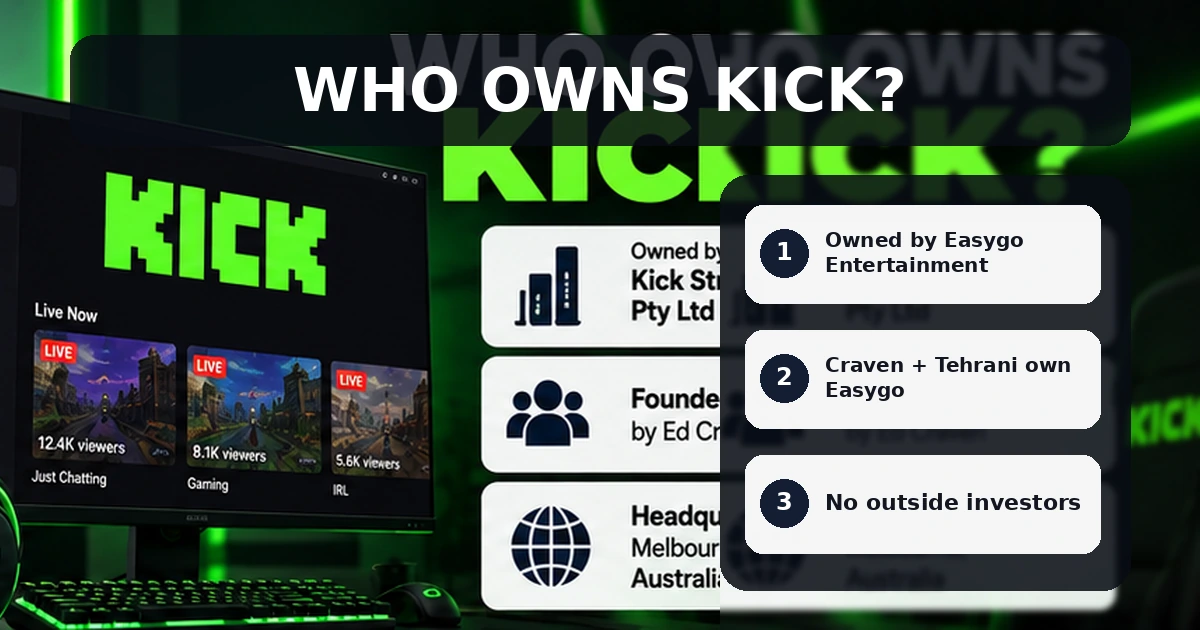
Kick is owned by Kick Streaming Pty Ltd, an Australian private company whose sole shareholder is Easygo Entertainment Pty Ltd. Easygo belongs to Stake.com co-founders Ed Craven and Bijan Tehrani, both Melbourne-based billionaires. Kick has never raised outside capital, and as of August 2026 it has no disclosed valuation.
Kick ownership at a glance
The chain runs two layers deep: Kick Streaming Pty Ltd sits under Easygo Entertainment Pty Ltd, which sits under Craven and Tehrani personally. Craven holds his interest through a private vehicle called Ashwood Holdings Pty Ltd.
| Ownership type | Private, wholly owned subsidiary |
|---|---|
| Parent company | Easygo Entertainment Pty Ltd |
| Largest shareholders | Bijan Tehrani; Ed Craven (via Ashwood Holdings Pty Ltd) |
| Latest valuation | Not disclosed |
| Last funding round or acquisition | None disclosed |
| Founded | Entity registered 14 November 2022; platform launched December 2022 |
| Headquarters | Melbourne, Victoria, Australia |
| CEO | Ed Craven |
Who owns Kick Streaming Pty Ltd today?
Easygo Entertainment holds every share in Kick Streaming Pty Ltd. There is no employee option pool disclosed on the public register, no venture fund on the cap table, and no minority holder of record.
Kick’s structure stayed hidden for the first months after launch. Crikey reported in March 2023 that the platform’s newly released iOS App Store listing confirmed Craven as a part-owner, matching what the outlet had reported weeks earlier.
Stake.com itself is not a shareholder. The connection runs through the two men who founded both businesses rather than through a direct corporate holding. Bloomberg reported in February 2026 that Stake and Kick operate from the same Melbourne headquarters, are both owned by Easygo, and share a number of executives and staff.
That arrangement gives Kick something almost no comparable platform has: a closed register. Anyone tracking how founder equity thins out across successive funding rounds will find no such pattern here, because there have been no rounds to dilute anyone.
Who owns Easygo Entertainment, Kick’s parent company?
Craven and Tehrani own Easygo between them. The exact split is where public sources disagree, and neither man has published a figure.
Wikipedia’s company infobox currently lists Ashwood Holdings at 50% and Tehrani at 50%. A number of secondary business profiles instead describe Tehrani holding roughly two-thirds and Ashwood Holdings roughly one-third. Australian private companies file limited shareholding detail, so the discrepancy has not been settled by primary records.
What is documented is that both men rank as billionaires. Forbes placed Craven and Tehrani jointly at #1913 on its 2026 Billionaires list. Forbes Australia valued each at US$2.8 billion in February 2025, a combined US$5.6 billion.
What else does Easygo own besides Kick?
Stake.com is the group’s revenue engine. Craven and Tehrani launched it in 2017 through Easygo, and Forbes reported its gross revenue reached $4.7 billion in 2024, up from roughly $105 million in 2020.
Stake.com gross revenue, 2020 to 2024 (US$ billions)
Those profits fund Kick. Craven told Tubefilter in July 2023 that Kick was not profitable and aimed to reach profitability through advertising within one to three years.
Easygo also runs Twist Gaming, a slot and table game studio launched the same year as Kick. In 2026 the group consolidated its content studios, including Twist Gaming, Massive Studios, Paperclip, Uppercut and Knucklehead Syndicate, under an Easygo Games banner. Easygo acquired Betfair Colombia and its licence to support Stake’s expansion there.
Outside the wholly owned brands, Craven and Tehrani acquired more than 5% of ASX-listed bookmaker PointsBet in May 2024. That is a minority position, not a controlled subsidiary.
Who are the biggest investors in Kick?
There are none beyond the founders. Kick has announced no seed round, no Series A, and no strategic investor, which puts it in a different category from nearly every platform of its size.
Spending has been heavy regardless. The New York Times reported in June 2023 that xQc signed a two-year, $70 million non-exclusive deal with incentives that could lift it to $100 million. Kick pays creators 95% of subscription revenue and keeps 5%, against Twitch’s historical 50/50 base split.
- Easygo Entertainment Pty Ltd, sole shareholder
- Bijan Tehrani, co-founder
- Ed Craven, co-founder and CEO, through Ashwood Holdings Pty Ltd
The closed structure contrasts sharply with the layered arrangements behind other large private tech firms, including the nonprofit and investor tiers set out in the ownership breakdown for OpenAI.
Is Kick publicly traded?
No. Kick has no ticker, no exchange listing, and no share available to retail investors. Neither Kick nor Easygo has announced an intention to list.
Because the company is founder-funded and discloses no audited financials, there is no public register of holders to examine, unlike the institutional and insider holdings behind Pinterest. For companies that have signalled listing plans, the current IPO pipeline tracks the disclosed candidates.
FAQ
Who founded Kick?
Ed Craven and Bijan Tehrani founded Kick in 2022. The pair had already co-founded the crypto casino Stake.com in 2017. Craven is Kick’s chief executive and is based in Melbourne.
Does Stake.com own Kick?
No. Stake.com is not a shareholder in Kick. Both brands sit under Easygo Entertainment, share a Melbourne headquarters and share executives, but neither owns the other.
Is Kick owned by Amazon or any other tech company?
No. Amazon owns Twitch, not Kick. Kick has no corporate parent outside Easygo Entertainment and has never taken investment from a large technology company.
What is Kick worth?
Kick has no confirmed valuation. It has raised no outside funding, publishes no audited financials, and its parent company files limited financial detail on the Australian register.
Why did Craven and Tehrani launch Kick?
Twitch banned unlicensed crypto gambling streams, including Stake.com content, in September 2022. Bloomberg reported that Craven started Kick two months later as a competitor built around looser content rules.
