
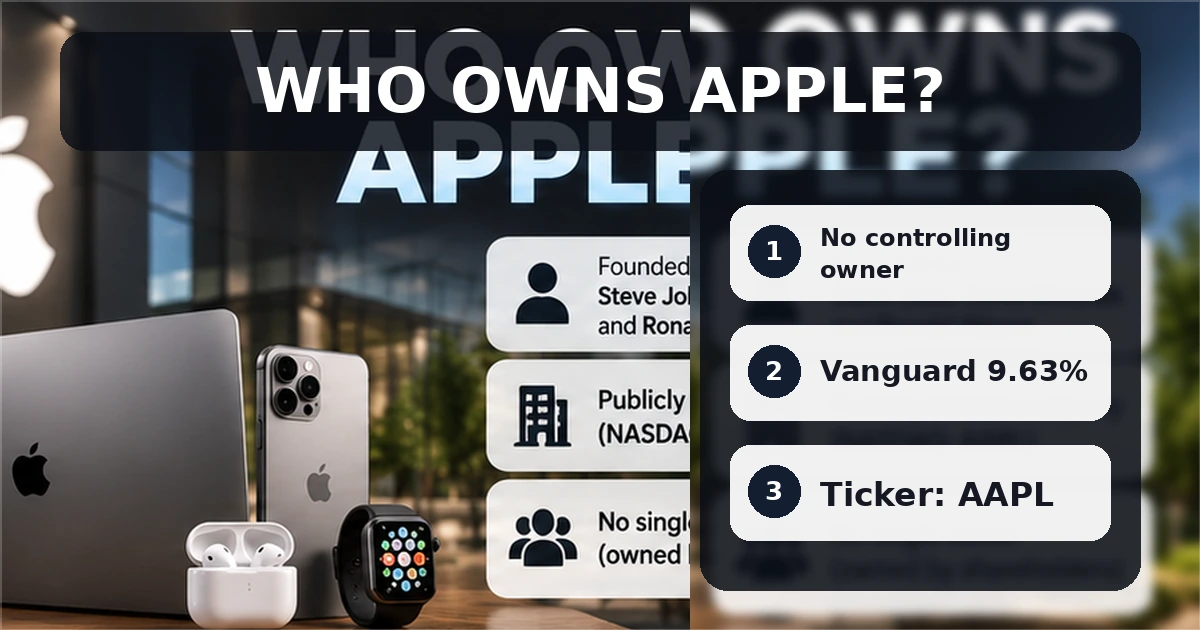
No single person or company owns Apple. The Vanguard Group is the largest shareholder with 9.63% of common stock as of January 2026, followed by BlackRock at 7.10%. Apple is a US public company based in Cupertino, California, with a market capitalization of about $4.54 trillion as of August 20, 2026.
Apple ownership at a glance
| Item | Detail |
|---|---|
| Ownership type | Public company, single class of common stock |
| Parent company | None, independent |
| Largest shareholders | Vanguard (9.63%), BlackRock (7.10%), State Street (about 4.1%) |
| Market cap | $4.54 trillion (August 20, 2026) |
| Last acquisition | PlasmaSolve, disclosed August 3, 2026 |
| Founded | April 1, 1976 |
| Headquarters | Cupertino, California, USA |
| CEO | Tim Cook through August 31, 2026; John Ternus from September 1, 2026 |
Who owns Apple today?
Apple’s 2026 proxy statement lists only two holders above the 5% disclosure threshold. Vanguard held 1,415,826,462 shares and BlackRock held 1,043,713,019 shares as of the January 2026 table date.
Both positions sit inside index funds and ETFs rather than active bets. Vanguard and BlackRock buy Apple because it is one of the heaviest weights in the S&P 500 and the total US market.
Insider ownership is small. All current directors and executive officers held 9,079,765 shares combined, under 1% of the company. Tim Cook held 3,280,295 shares and board chair Art Levinson held 4,126,689.
Apple had roughly 14.68 billion shares outstanding as of January 16, 2026. The remaining shares are split between thousands of smaller institutions and millions of retail investors, a structure closer to the shareholder mix behind Pinterest than to a founder-controlled tech company.
Who controls Apple?
Control and economic ownership are the same thing at Apple. The company has one class of common stock and one vote per share, so no founder, family, or trust holds enhanced voting rights.
The arrangement differs from the nonprofit-controlled structure at OpenAI, where final authority sits with a board rather than with shareholders.
That leaves the board as the main control mechanism. Eight directors stood for election at the February 24, 2026 annual meeting, and every one except Tim Cook is classified as independent under Nasdaq rules.
Art Levinson has chaired the board since 2011. On September 1, 2026, Cook becomes executive chairman, John Ternus joins the board as CEO, and Levinson moves to lead independent director.
Shareholders holding 10% of outstanding stock can call a special meeting. Up to 20 shareholders who together own 3% for three years can nominate directors through the proxy access provision in Apple’s bylaws.
Who are Apple’s largest shareholders?
Institutions hold roughly 65% of Apple stock, according to Yahoo Finance data cited by TheStreet in March 2026. Trackers disagree on the exact figure, with estimates running from about 63% to 74% depending on how custodial holdings are counted.
Insiders hold about 0.12%. Retail investors own the balance, which is unusually large for a company this size because Apple has been a default holding in individual brokerage accounts for two decades.
Largest Apple shareholders by percentage of shares outstanding
The five largest institutional positions reported for the December 2025 quarter were Vanguard at 1.43 billion shares, BlackRock at 1.15 billion, State Street at 604 million, Geode Capital Management at 358 million, and Fidelity parent FMR at 307 million.
Berkshire Hathaway ranks seventh with about 228 million shares. Norges Bank, Morgan Stanley, JPMorgan Chase, and Northern Trust each hold between 160 million and 231 million shares.
Who are the biggest investors in Apple?
Four passive managers, Vanguard, BlackRock, State Street, and Geode, together control more than 23% of the company. None of them picked Apple; their stakes track index weightings.
Berkshire Hathaway is the exception. Warren Buffett’s firm bought in during 2016 and sold heavily through 2024 and 2025, cutting the position from more than 900 million shares to roughly 228 million.
Berkshire made no change to the holding in its second-quarter 13F, filed August 14, 2026, its first full quarter under CEO Greg Abel. Apple still accounts for 22% of Berkshire’s $299.3 billion equity portfolio.
Is Apple publicly traded?
Apple trades on the Nasdaq under the ticker AAPL. It went public on December 12, 1980, selling 4.6 million shares at $22 each.
The company reported revenue of $109.4 billion for the quarter ended June 27, 2026, up 16% year over year, and declared a quarterly dividend of $0.27 per share. Investors tracking newer names can follow which AI companies are lining up to list against that benchmark.
FAQ
Who founded Apple?
Steve Jobs, Steve Wozniak, and Ronald Wayne founded Apple on April 1, 1976. Wayne sold his 10% stake back to Jobs and Wozniak for $800 less than two weeks later.
Does Microsoft own part of Apple?
No. Microsoft bought $150 million of non-voting Apple shares in August 1997 as part of a patent and software agreement, then sold the position in the early 2000s. It holds no stake today.
Who is Apple’s largest shareholder?
The Vanguard Group, with 1,415,826,462 shares, or 9.63% of common stock, as of the January 2026 date used in Apple’s proxy statement. BlackRock is second at 7.10%.
Does Warren Buffett still own Apple stock?
Yes. Berkshire Hathaway held about 228 million Apple shares as of its August 14, 2026 filing, down from a peak above 900 million. Apple remains its largest equity position at 22% of the portfolio.
Who is Apple’s CEO?
Tim Cook holds the role through August 31, 2026. John Ternus, previously senior vice president of hardware engineering, becomes CEO on September 1, 2026, while Cook moves to executive chairman.
