
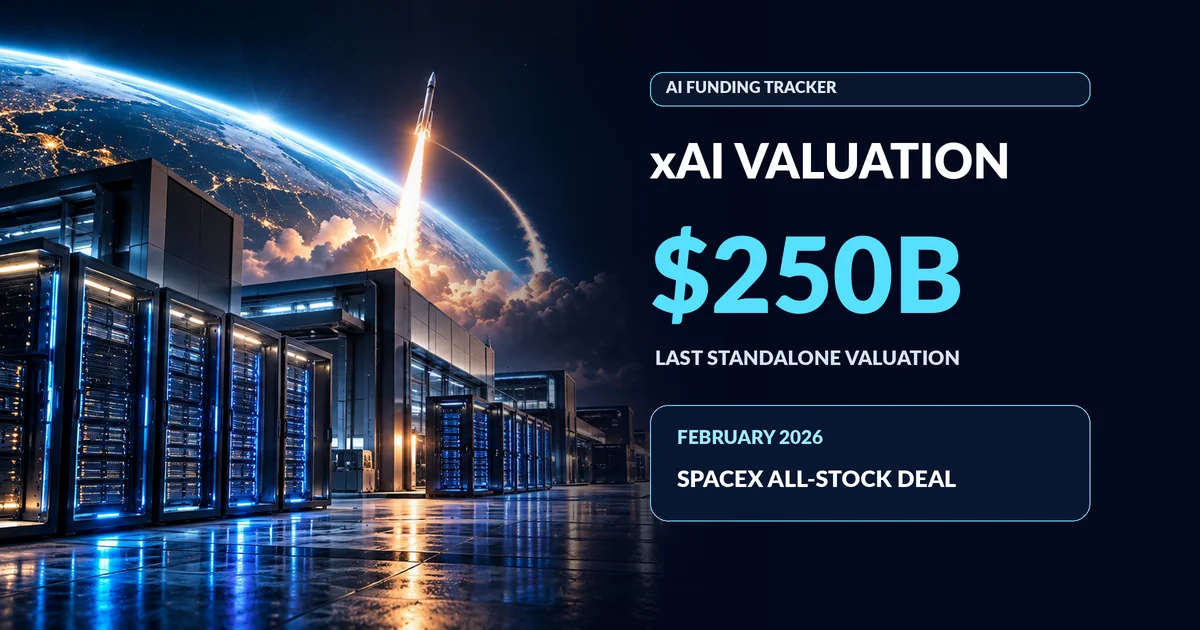
xAI’s last standalone valuation was $250 billion. SpaceX set that figure on February 2, 2026, when it acquired xAI in an all-stock deal that valued SpaceX at $1 trillion and the combined company at $1.25 trillion.
A month earlier, xAI had closed a $20 billion Series E at a valuation of about $230 billion. xAI now runs as SpaceX’s AI division, so its value sits inside SpaceX stock, which began trading on Nasdaq in June 2026.
xAI valuation in 2026: key figures
| Metric | Figure | Date or period |
|---|---|---|
| Last standalone valuation | $250 billion | February 2026 |
| Last funding round | $20 billion Series E at about $230 billion | January 2026 |
| SpaceX and xAI combined value at merger | $1.25 trillion | February 2026 |
| Share exchange ratio | 0.1433 SpaceX shares per xAI share | February 2026 |
| Total raised before the merger | About $50 billion across 15 rounds | 2023 to 2026 |
| AI segment revenue | $3.2 billion | 2025 |
| AI segment operating loss | $6.36 billion | 2025 |
| SpaceX IPO price | $135 per share, about $1.75 trillion | June 11, 2026 |
xAI valuation history from 2024 to 2026
Elon Musk founded xAI in 2023. Its valuation rose more than tenfold between its Series B in May 2024 and the SpaceX deal less than two years later.
| Date | Event | xAI valuation |
|---|---|---|
| May 2024 | $6 billion Series B | $24 billion |
| December 2024 | $6 billion Series C | About $50 billion |
| March 2025 | All-stock merger with X | $80 billion ($113 billion combined) |
| July 2025 | $10 billion debt and equity raise | About $150 billion |
| January 2026 | $20 billion Series E | About $230 billion |
| February 2026 | Acquired by SpaceX | $250 billion |
Backers across these rounds included Valor Equity Partners, Andreessen Horowitz, Sequoia Capital, BlackRock, Morgan Stanley, Nvidia and Cisco Investments. CB Insights counts about $50 billion raised across 15 rounds before the merger.
How the SpaceX acquisition set xAI’s valuation
The February 2026 merger was an all-stock deal. Each xAI share converted into 0.1433 SpaceX shares, which valued xAI at $250 billion and SpaceX at $1 trillion.
That price was $20 billion above the Series E mark from January. It also covered X, the social platform xAI had absorbed in March 2025.
By May 2026, xAI had been folded into SpaceX as its AI unit. Grok, the X platform and the Colossus data centers now report as one AI segment in SpaceX’s filings.
The ownership chain behind Grok follows the same path: Grok belongs to xAI, and xAI belongs to SpaceX.
xAI’s revenue and losses in the SpaceX S-1
SpaceX’s IPO filing gave the first public view of xAI’s finances. The AI segment, which covers xAI and X, recorded $3.2 billion in revenue in 2025 and an operating loss of $6.36 billion.
The loss grew from $1.56 billion in 2024. The segment spent $5.1 billion on research and development in 2025, more than its revenue, and $12.7 billion on capital expenditure.
Spending kept rising in 2026. In Q1, the AI segment posted $818 million in revenue, a $2.47 billion operating loss and $7.72 billion in capital expenditure, more than SpaceX’s space and connectivity segments combined.
Valuation multiple and users
At $250 billion, xAI was valued at about 78 times its 2025 segment revenue. Grok and X had 550 million combined monthly active users as of March 2026, and 117 million of them used Grok’s AI features, per the filing.
The segment also earns by renting compute. The S-1 disclosed that Anthropic pays SpaceX $1.25 billion per month through May 2029 for capacity at xAI’s Colossus data centers.
xAI valuation compared with OpenAI and Anthropic
| Company | Latest private valuation | Deal | Date |
|---|---|---|---|
| Anthropic | $965 billion | $65 billion Series H | May 2026 |
| OpenAI | $852 billion | $122 billion round | March 2026 |
| xAI | $250 billion | SpaceX all-stock acquisition | February 2026 |
xAI’s mark sits well below both rivals. Anthropic’s run-rate revenue passed $47 billion in May 2026, more than ten times xAI’s 2025 segment revenue.
The three companies also differ in structure, and this look at how OpenAI’s ownership is split shows a very different cap table from xAI’s.
Can you invest in xAI?
xAI shares no longer trade on their own. Public investors can only get exposure to xAI through SpaceX stock, listed on Nasdaq under the ticker SPCX.
SpaceX priced its IPO at $135 per share on June 11, 2026, raising about $75 billion, the largest IPO on record. Shares began trading on June 12.
A SpaceX share covers Starlink, the launch business and xAI together. Starlink produced $11.4 billion of SpaceX’s $18.7 billion in 2025 revenue, with $4.42 billion in operating income.
Musk keeps majority voting control after the listing, the S-1 states. Other companies in the queue appear in this tracker of AI firms preparing to go public. This information is not investment advice.
What affects xAI’s value inside SpaceX
Cash burn is the first factor. The AI segment lost $6.36 billion from operations in 2025, and Starlink’s profits now cover that gap.
Compute is the second. The AI segment ran about 1 gigawatt of capacity at the time of the filing, and capital spending in Q1 2026 alone reached $7.72 billion.
Outside revenue is the third. The Anthropic compute contract adds $15 billion a year through May 2029, which is more than four times xAI’s 2025 segment revenue.
FAQ
What is xAI’s valuation?
xAI’s last standalone valuation was $250 billion, set when SpaceX acquired it in February 2026. It no longer has a separate valuation because it now operates inside SpaceX.
Who owns xAI?
SpaceX owns xAI after their all-stock merger closed in February 2026. Elon Musk controls SpaceX and kept majority voting power after its June 2026 IPO.
Can I buy xAI stock?
No. xAI shares converted into SpaceX shares at 0.1433 per share. Public investors can only get exposure through SpaceX stock, which trades on Nasdaq as SPCX.
How much money did xAI raise?
CB Insights records about $50 billion raised by xAI across 15 rounds before the SpaceX deal, including a $20 billion Series E in January 2026.
Is xAI profitable?
No. SpaceX’s S-1 shows the AI segment, which includes xAI and X, lost $6.36 billion from operations in 2025 on $3.2 billion of revenue.
