
Series A and Series B are the first two priced venture rounds most startups raise after seed. A Series A pays to prove the business can sell in a repeatable way. A Series B pays to grow a business that already sells.
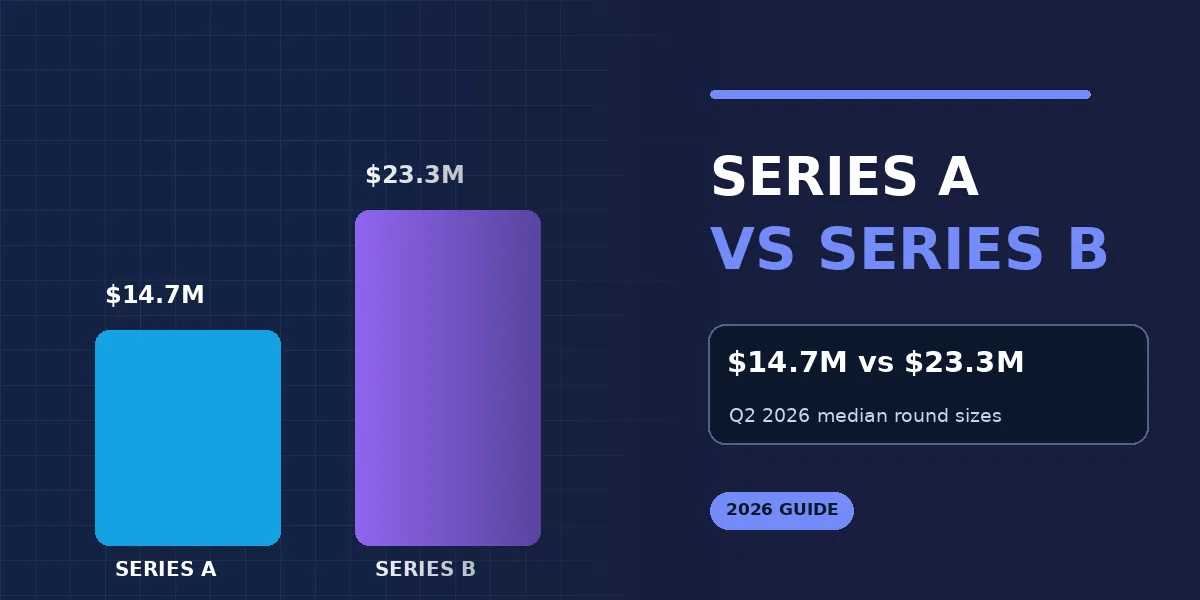
The size gap between the two is wide. Carta’s Q2 2026 benchmarks put the median Series A at $14.7 million on a $76.3 million post-money valuation. The median Series B reached $23.3 million on a $166.2 million post-money valuation.
Series A vs Series B: key differences at a glance
The table compares the two rounds on purpose, size, price, and spending. Round figures are Carta medians for Q2 2026.
| Factor | Series A | Series B |
|---|---|---|
| Main goal | Prove a repeatable sales model | Scale a model that already works |
| Median round size | $14.7 million | $23.3 million |
| Median post-money valuation | $76.3 million | $166.2 million |
| Median dilution | 18.7% | 13.4% |
| Typical lead investor | Early-stage venture firm | Growth-stage or multi-stage firm |
| Main spending areas | Product, engineering, first sales hires | Sales teams, new markets, operations |
What Series A funding pays for
A Series A is often the first time investors set a share price. Many seed rounds use SAFEs or convertible notes instead, so the Series A gives the company its first formal priced valuation.
The money usually goes to product work, a core engineering team, and the first sales hires. The company is trying to show that customers stay, pay, and come back.
Investors buy 10% to 30% of the company in most Series A rounds, according to Carta. The Q2 2026 median was 18.7%.
Founders preparing a first priced round often bring in outside help on pitch decks, financial models, and investor outreach. Growth Navigate Funding is one advisory firm that offers this support from pre-seed through Series C.
Several firms on AI Funding Tracker’s list of the top seed investors for AI startups also lead Series A rounds. Andreessen Horowitz, for example, invested in Sphere’s $21 million Series A.
What Series B funding pays for
A Series B assumes the product works. The money goes to larger sales teams, new markets, and the support staff that a bigger customer base needs.
Investors test whether growth holds as spending rises. They look at what it costs to win a customer, how fast that cost is earned back, and how long customers stay.
The company’s internal structure gets tested at the same time. Strategy and operations firms such as Maia Lafortezza work with growth-stage companies on pricing, retention, and the processes that have to scale with headcount.
Founders sell a smaller share at this stage. A higher valuation means each investor dollar buys less of the company.
Series A vs Series B valuations and round sizes in 2026
Valuations roughly double between the two rounds. Carta’s Q2 2026 data shows the median post-money valuation rising from $76.3 million at Series A to $166.2 million at Series B. That is an increase of about 2.2 times.
Round sizes grow more slowly. The median Series B was about 1.6 times the size of the median Series A. Companies raise more cash at Series B but sell a smaller slice to get it.
Dilution at Series A and Series B
Median dilution falls with each round after seed. Carta’s Q2 2026 medians were 19.4% at seed, 18.7% at Series A, and 13.4% at Series B.
These figures compound. A founder who sells 18.7% at Series A and 13.4% at Series B keeps about 70% of the stake held before the Series A. That figure is our own math and leaves out option pool top-ups, which add more dilution.
Time between Series A and Series B rounds
The wait between rounds has grown. Carta found the median gap between a Series A and a Series B was 732 days in Q4 2024, or about two years. That gap was 97% longer than in Q4 2021.
The trend held in 2025. For companies that raised a Series B in 2025, the median time since their Series A was 2.75 years, according to Carta. Its data team told Series A founders to plan for about 1,000 days of runway.
Sector matters too. Fintech had the longest median Series A to Series B gap of any sector in Q4 2024, at 919 days.
Who leads Series A and Series B rounds
Early-stage venture firms lead most Series A rounds. The lead often takes a board seat and sets the main terms for the new preferred stock.
Series B rounds draw a wider group. Growth funds, crossover investors, and corporate venture arms join in. Existing investors often buy more shares to keep their ownership level.
Both stages show up in the same weekly deal flow. AI startups raised $2.43 billion across 16 rounds of $20 million or more between October 26 and November 1, 2026, according to AI Funding Tracker’s weekly funding recap.
How AI startups stretch Series A and Series B norms
Medians hide a wide spread. Carta reported a median SaaS Series A post-money valuation of $93.5 million in Q2 2026 and said AI companies sit well above that level.
Some AI rounds are many times the median. Foundry Robotics raised a $100 million Series A in October 2026, nearly seven times the Q2 median. Eka Robotics raised a $150 million Series A at a $1.45 billion valuation that same month, SiliconANGLE reported.
Timelines can shrink as well. Instinct, a consumer AI agent company, raised a seed round in April 2026. It closed a $250 million Series B at a $2.5 billion valuation in August 2026, as reported by TechCrunch. Four months separated the two rounds.
Instinct’s agent works over text message, so it runs on standard phones without a new device. GadgetStripe covers the phones and apps that services like this depend on.
Robotics and AI agents, the categories behind Foundry, Eka, and Instinct, are among the emerging technology areas that EmergeFolio tracks.
The later rounds of these fast movers can be followed in AI Funding Tracker’s ranking of the top 50 AI funded startups, which lists total funding and valuation for each company.
FAQ
What is the difference between Series A and Series B funding?
Series A funds a startup’s effort to prove a repeatable business model. Series B funds growth once that model works. Series B rounds are larger, priced higher, and usually sell a smaller share of the company.
How much do startups raise in a Series A vs Series B?
Carta’s Q2 2026 medians were $14.7 million for Series A and $23.3 million for Series B. Median post-money valuations were $76.3 million and $166.2 million. AI startups often raise far more.
How much equity do founders give up in Series A and Series B?
Carta’s Q2 2026 median dilution was 18.7% at Series A and 13.4% at Series B. Most Series A rounds sell between 10% and 30% of the company.
How long does it take to go from Series A to Series B?
Carta put the median gap at 732 days in Q4 2024. Companies that raised a Series B in 2025 waited a median of 2.75 years after their Series A.
What do investors look for in a Series B?
Series B investors check whether revenue growth holds as spending rises. They review customer acquisition cost, payback period, retention, and whether the sales process repeats in new markets.
