
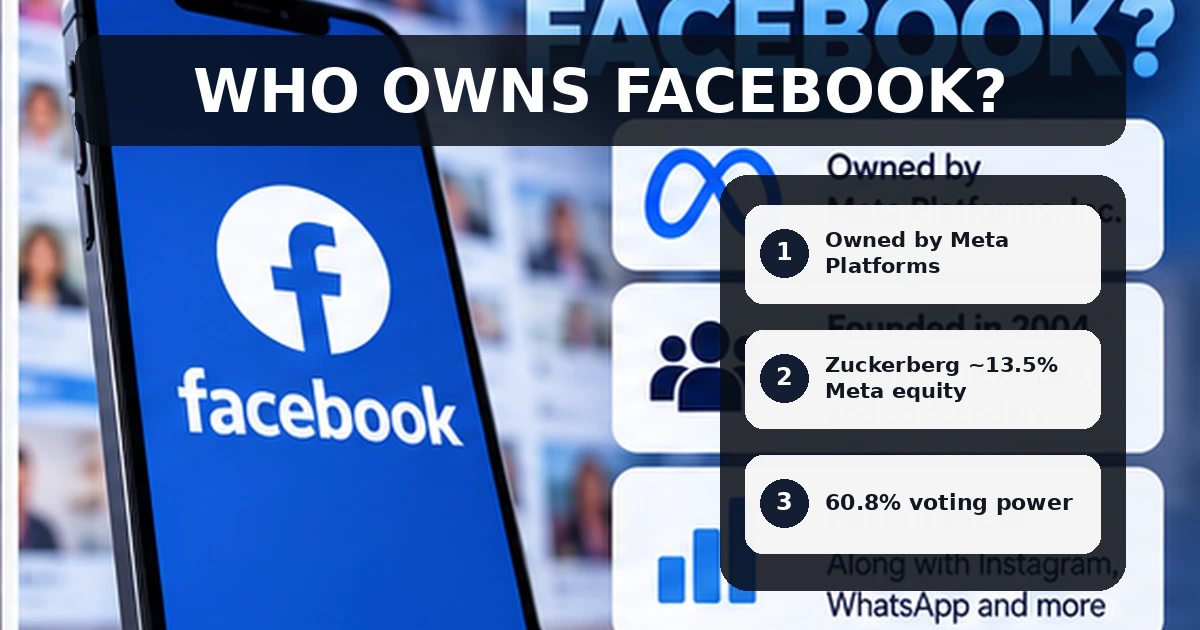
Facebook is owned by Meta Platforms, Inc., a public American company that trades on Nasdaq under the ticker META. Facebook is a product inside Meta rather than a separate business, so it has no investors or balance sheet of its own. Meta’s market value was about $1.39 trillion on August 20, 2026.
Facebook ownership at a glance
| Ownership type | Product owned by a listed parent company |
|---|---|
| Parent company | Meta Platforms, Inc. (Nasdaq: META) |
| Largest shareholders | Mark Zuckerberg, Vanguard, BlackRock, FMR |
| Parent market cap | $1.39 trillion (August 20, 2026) |
| Last major acquisition | 49% of Scale AI for $14.3 billion (June 2025) |
| Founded | February 4, 2004, Cambridge, Massachusetts |
| Headquarters | Menlo Park, California |
| CEO | Mark Zuckerberg (Tom Alison heads the Facebook app) |
Who owns Facebook today?
Meta had 2,196,045,588 Class A shares and 342,377,716 Class B shares outstanding as of April 1, 2026, according to its 2026 proxy statement.
Zuckerberg held 99.8% of the Class B stock on that date, which works out to roughly 13.5% of all shares. Every other holder owns Class A stock.
Vanguard Capital Management reported 163,839,861 shares, or 7.49% of the class, as of March 31, 2026. The proxy lists BlackRock entities at 7.2% of Class A and FMR, Fidelity’s parent, at 6.1%.
Retail investors, index funds and pension funds hold the rest. None of them owns Facebook the product directly; they own a claim on Meta’s earnings, which came to $15.85 billion in the second quarter of 2026 on revenue of $60.80 billion. The split resembles the shareholder structure at Pinterest, where founders keep supervoting stock while institutions absorb the float.
Who controls Facebook after the dual-class split?
Ownership and control are separate at Meta. Class A shares carry one vote each and Class B shares carry ten, and Zuckerberg controlled 60.8% of total voting power as of April 1, 2026.
That majority makes Meta a controlled company under Nasdaq rules, which exempts it from requirements on board independence. The board opted into those standards anyway: eleven of the twelve directors elected in May 2026 are independent, and Robert Kimmitt is lead independent director.
Shareholders have tested the arrangement and lost. A proposal to move to one vote per share drew about 26% support at the May 27, 2026 annual meeting, and all ten shareholder proposals were defeated.
Meta voting power by holder, April 2026 (%)
What else does Meta own besides Facebook?
Meta bought Instagram in April 2012 for about $1 billion and WhatsApp in February 2014 in a deal valued at $19 billion at announcement. Oculus followed in March 2014 for roughly $2 billion, and now anchors the Reality Labs hardware unit.
Messenger and Threads were built in house. Facebook, Instagram, Messenger and WhatsApp sit in the Family of Apps segment, which produced $23.39 billion of operating profit in the second quarter of 2026 while Reality Labs lost $4.62 billion.
The newer spending goes to artificial intelligence. Meta paid $14.3 billion for 49% of Scale AI in June 2025 and hired founder Alexandr Wang, and it has since expanded its chip supply arrangement with Nvidia and launched a cloud unit.
Facebook ownership history from 2004 to 2026
Zuckerberg launched thefacebook.com from a Harvard dorm on February 4, 2004 with Eduardo Saverin, Dustin Moskovitz, Andrew McCollum and Chris Hughes.
Peter Thiel put in $500,000 in August 2004 for a 10.2% stake. Accel Partners led a $12.7 million round in May 2005 for about 11%, and Greylock and Meritech Capital supplied $27.5 million in April 2006.
Microsoft paid $240 million in October 2007 for 1.6%, a price that valued the company at $15 billion. The IPO came on May 18, 2012 at $38 a share, raising about $16 billion at a $104 billion valuation.
Facebook, Inc. renamed itself Meta Platforms on October 28, 2021. Facebook kept its name as an app. Meta stopped disclosing app-level user counts after 2023, when Facebook averaged 2.11 billion daily users in December 2023 and reported 3.07 billion monthly users. The current measure, family daily active people, reached 3.60 billion in June 2026.
Is Facebook publicly traded?
Facebook cannot be bought as a standalone stock. Buying Meta Class A shares on Nasdaq is the only way to own a share of it, and those shares carry one vote each.
Class B stock does not trade publicly and converts to Class A one for one when sold. Meta has paid a quarterly dividend since 2024 and returned $1.3 billion to shareholders in the first quarter of 2026. Investors watching for newer listings can track the AI companies still queued for a public debut.
FAQ
Who owns Facebook?
Meta Platforms, Inc. owns Facebook. Meta is a public company on Nasdaq, and founder Mark Zuckerberg holds about 13.5% of its shares and 60.8% of its voting power as of April 2026.
Does Mark Zuckerberg own Facebook outright?
No. He owns roughly 13.5% of Meta’s equity. His Class B shares carry ten votes each, giving him 60.8% of voting power, so he controls the company without owning most of it.
Is Facebook owned by Microsoft or Google?
Neither. Microsoft bought a 1.6% stake for $240 million in October 2007 and later sold down. Google has never held a position in Facebook or its parent, Meta Platforms.
Who founded Facebook?
Mark Zuckerberg, Eduardo Saverin, Dustin Moskovitz, Andrew McCollum and Chris Hughes launched the site at Harvard on February 4, 2004. Only Zuckerberg still works at the company.
Can you buy shares in Facebook itself?
No. Facebook has no separate stock. Investors buy Meta Class A shares under the ticker META, which represent the whole company, including Instagram, WhatsApp and Reality Labs.
