

No parent company owns Spotify. Spotify Technology S.A. is registered in Luxembourg and trades on the New York Stock Exchange, where its market value was about $106 billion in mid-August 2026. Co-founders Daniel Ek and Martin Lorentzon are the largest individual holders, with roughly 14.3% and 9.8% of ordinary shares.
Spotify ownership at a glance
Ownership splits between the two founders, large fund managers, four Tencent entities, and retail investors who bought in after the 2018 direct listing. Voting power is a separate question, because the founders hold instruments that carry votes and no economic value.
| Ownership type | Public company, no controlling corporate shareholder |
|---|---|
| Parent company | None, independent |
| Largest shareholders | Martin Lorentzon, Tencent entities, Daniel Ek, BlackRock, Baillie Gifford |
| Market cap | About $106 billion, mid-August 2026 |
| Last equity event | Direct listing, April 3, 2018 (no new shares issued) |
| Founded | 2006, Stockholm |
| Headquarters | Registered in Luxembourg, operations run from Stockholm |
| CEO | Alex Norström and Gustav Söderström, co-CEOs since January 1, 2026 |
Who owns Spotify today?
Spotify had 205,832,527 ordinary shares outstanding on December 31, 2025, according to the Form 20-F it filed on February 10, 2026.
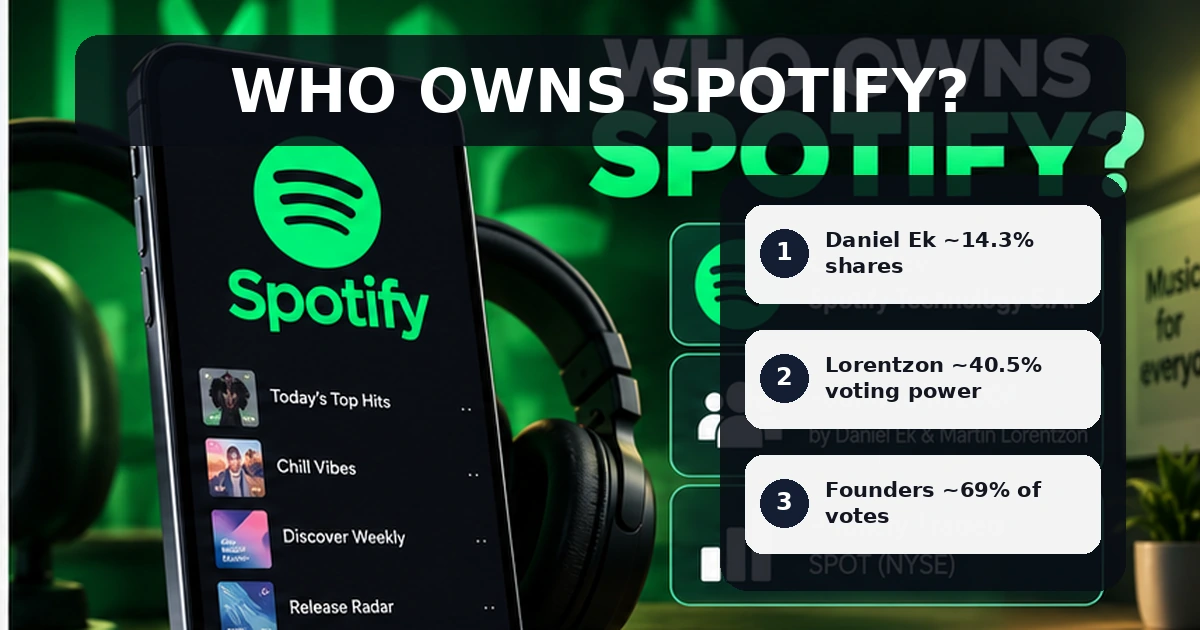
Ek is listed as the beneficial owner of about 29.1 million of those shares, or 14.3%. That number overstates what he owns outright.
Roughly 16.6 million of them sit with four Tencent-linked entities: TME Hong Kong, Image Frame Investment, Tencent Mobility and Distribution Pool. Ek’s Cyprus company, D.G.E. Investments, holds an irrevocable proxy over that block.
Lorentzon holds close to 20 million shares, or 9.8%. Most are held by Rosello Company Limited, a Cyprus entity owned through Amaltea S.à r.l., where he is the sole shareholder.
Institutions hold most of the remainder. Employee options and restricted stock are settled with new or treasury shares, and Spotify does not report the pool as a fixed percentage, which is common once founder stakes settle after the growth-round years.
Who controls Spotify?
Control and ownership separate cleanly here. Every ordinary share carries one vote. Spotify has also issued beneficiary certificates, which carry one vote each and no economic rights.
There were 309,932,980 of them outstanding on December 31, 2025, down from 324,732,980 a year earlier. They go only to entities owned by Ek and Lorentzon, at ten certificates per ordinary share held of record, and they are cancelled for no payment if the linked share is sold.
The result: Lorentzon held about 40.5% of total voting power at the end of 2025 and Ek about 28.8%, or roughly 69% between them. The mechanism differs from the weighted share classes used by Pinterest and other founder-led consumer platforms.
Shareholders elected 12 directors at the April 15, 2026 annual meeting: A directors Ek, Lorentzon and Shishir Mehrotra, plus nine B directors including Ted Sarandos, Barry McCarthy and Padmasree Warrior.
Spotify ownership versus voting power, December 31, 2025
Who are Spotify’s largest shareholders?
Institutional managers hold roughly two-thirds of the ordinary shares. Individual insiders account for about 16%, and retail investors for most of the rest.
By record holding rather than beneficial ownership, Lorentzon is first at about 9.7%. The Tencent entities together hold 8.1%, and D.G.E. Investments holds 6.1% directly.
BlackRock is the largest institutional holder at about 5.6%, followed by Baillie Gifford at 4.1%. State Street, Capital Research, T. Rowe Price and Morgan Stanley Investment Management each hold between 1.7% and 2.3%.
None of them carry weight in a vote. Baillie Gifford’s 4.1% economic stake translates to under 2% of total votes once the beneficiary certificates are counted.
Who are the biggest investors in Spotify?
Baillie Gifford has been the most active long-term holder. The Edinburgh firm owned about 12% of Spotify at the end of 2023 and has cut that position by roughly two-thirds since. BlackRock has moved the other way, adding shares across recent quarters.
The largest reported holders as of mid-2026:
- Martin Lorentzon, about 9.7%
- Tencent entities, about 8.1%
- D.G.E. Investments (Daniel Ek), about 6.1%
- BlackRock, about 5.6%
- Baillie Gifford, about 4.1%
- State Street Global Advisors, about 2.3%
Tencent’s stake came from a 2017 share swap. Spotify received shares in Tencent Music Entertainment, which remain its largest long-term investment, and a cross-holding of the kind that also shows up in the layered cap table behind OpenAI.
Is Spotify publicly traded?
Yes. Spotify trades on the New York Stock Exchange under the ticker SPOT. It went public through a direct listing on April 3, 2018, opening at a market value near $26.4 billion without issuing new shares.
The stock traded between $405 and $745 over the past 52 weeks and sat near $536 on August 21, 2026. Spotify pays no dividend. Shareholders approved a 10 million share repurchase authorisation in April 2026, and the company added $1.5 billion to the program in August. Its route to the market still stands apart from the conventional IPO pipeline tracked across the AI sector.
FAQ
Who founded Spotify?
Daniel Ek and Martin Lorentzon founded Spotify in Stockholm in 2006. Both remain on the board. Ek became executive chairman on January 1, 2026, after 20 years as chief executive.
Does Tencent own Spotify?
No. Tencent entities hold about 8.1% of ordinary shares from a 2017 share swap. Daniel Ek’s holding company votes those shares under an irrevocable proxy, so Tencent has economic exposure without voting influence.
Who is the CEO of Spotify?
Alex Norström and Gustav Söderström have served as co-CEOs since January 1, 2026. They report to Daniel Ek, who moved from chief executive to executive chairman on the same date.
Is Spotify owned by a record label?
No. Sony Music, Universal Music Group and Warner Music took equity stakes before the 2018 listing and sold most of them afterward. Spotify licenses content from all three rather than being owned by them.
Can Spotify be acquired?
Only with founder consent. Ek and Lorentzon controlled roughly 69% of voting power at the end of 2025 through ordinary shares and beneficiary certificates, which blocks any hostile bid or activist campaign.
