
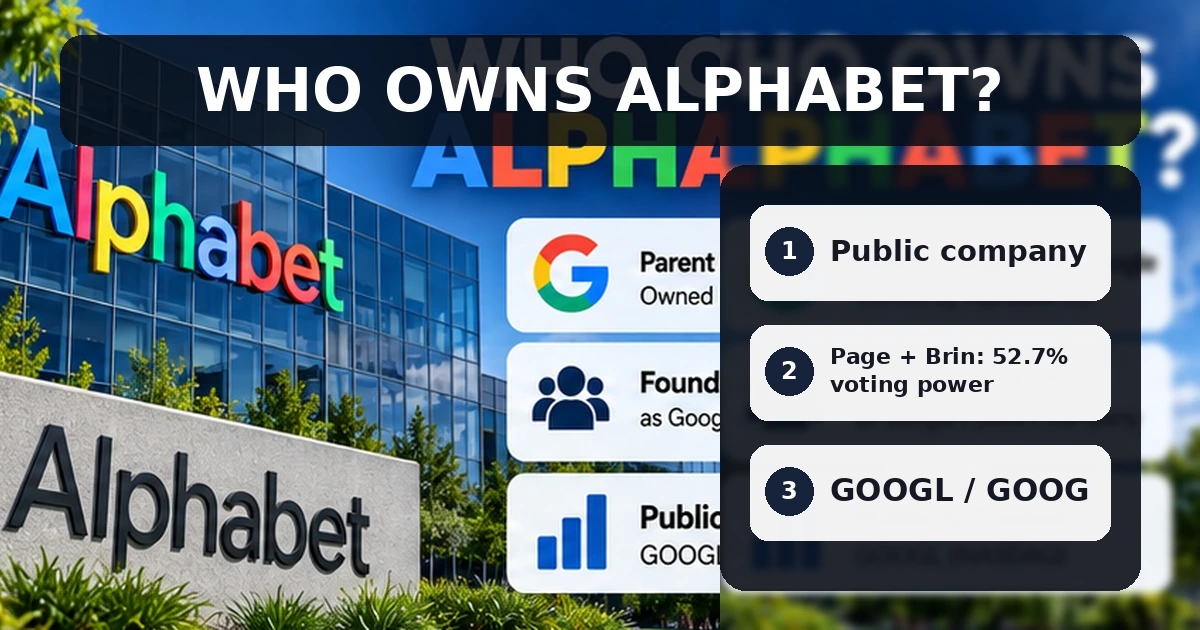
Alphabet Inc. has no parent company. It is a publicly traded American business listed on Nasdaq with a market capitalization of roughly $4.2 trillion as of August 19, 2026. Co-founders Larry Page and Sergey Brin together hold 52.7% of the voting power, while index managers such as BlackRock hold the largest economic stakes.
Alphabet ownership at a glance
| Ownership type | Public company, dual-class voting structure |
|---|---|
| Parent company | None — independent |
| Largest shareholders | Larry Page and Sergey Brin (voting control); BlackRock and Berkshire Hathaway (economic stakes) |
| Market capitalization | About $4.2 trillion (August 19, 2026) |
| Last capital raise | $84.75 billion equity offering priced June 2026 |
| Founded | Google, September 1998; Alphabet holding structure, October 2015 |
| Headquarters | Mountain View, California |
| CEO | Sundar Pichai |
Who owns Alphabet today?
Alphabet has three share classes. Class A carries one vote per share, Class B carries ten votes and does not trade publicly, and Class C carries no votes at all.
The April 2026 proxy statement counted 5,823,665,113 Class A shares and 835,779,041 Class B shares outstanding as of April 6, 2026. Class C shares sit outside that table.
Page held 389,051,160 Class B shares, or 46.5% of the class. Brin held 358,939,978 Class B shares, 42.9% of the class, plus 37,469 Class A shares.
Director L. John Doerr controlled 22,348,940 Class B shares through the Vallejo Ventures Trust, 2.7% of the class. Pichai held 227,560 Class A shares.
Directors and executive officers as a group, 14 people, held 92.2% of all Class B stock. Because the proxy table excludes non-voting Class C, it does not disclose total economic ownership for any insider.
Who controls Alphabet?
Control and economic ownership are separate at Alphabet. Page holds 27.4% of total voting power and Brin holds 25.3%, giving the two founders 52.7% between them as of April 6, 2026.
Directors and officers as a group hold 54.3%. That majority decides board elections and every other item put to shareholders.
Shareholders voted on a proposal for equal voting rights at the June 5, 2026 annual meeting. The board recommended a vote against it, arguing the existing structure supports long-term capital allocation.
The board has ten directors, seven of them independent. John L. Hennessy is independent chair, a role kept separate from the CEO position. Page chairs the Executive Committee alongside Brin and Pichai. A Risk and Compliance Committee was added in October 2025.
Alphabet total voting power, April 6, 2026
Who are Alphabet’s largest shareholders?
Insiders dominate voting; institutions dominate economics. BlackRock was the only outside holder above 5% named in the 2026 proxy, with 356,934,964 Class A shares, or 6.1% of the class and 2.5% of total voting power.
Vanguard previously reported 493,782,758 Class A shares, about 8.5% of the class and 3.5% of the vote. In a March 2026 amendment, Vanguard disclosed that an internal realignment effective January 12, 2026 removed beneficial ownership at the group level, with subsidiaries now reporting separately.
Berkshire Hathaway became the largest new holder. Its second-quarter 13F showed close to 106 million Class A and Class C shares worth about $36.6 billion at June 30, 2026, ranking Alphabet third in the portfolio behind Apple and American Express.
Retail investors hold the remaining float across GOOGL and GOOG. None of them vote in a way that changes outcomes while Class B stays outstanding.
Who are the biggest investors in Alphabet?
The register is led by passive index managers, with one large active buyer added in 2026. Alphabet raised $84.75 billion in June 2026 to fund AI infrastructure, its first equity issuance in more than two decades, and $10 billion of that came from Berkshire in a private placement.
Alphabet also invests on the other side of the table. Its holding in Anthropic’s investor group is one of the larger corporate positions in a private AI lab.
Revenue from its own models has drawn attention to how Gemini compares with ChatGPT and Claude on users and pricing.
- Larry Page — 27.4% of voting power
- Sergey Brin — 25.3% of voting power
- BlackRock — 6.1% of Class A shares
- Berkshire Hathaway — about 106 million Class A and C shares
- L. John Doerr — 2.7% of Class B shares
Is Alphabet publicly traded?
Yes. Class A trades on Nasdaq as GOOGL and Class C trades as GOOG. Class B is unlisted and converts into Class A on a one-for-one basis at the holder’s request.
Google went public on August 19, 2004, selling 19,605,052 Class A shares at $85 in a modified Dutch auction that raised $1.67 billion and valued the company near $23 billion. Several large AI companies remain in the IPO pipeline by comparison.
Frequently asked questions
Who founded Alphabet?
Larry Page and Sergey Brin founded Google in September 1998 as Stanford graduate students. They created Alphabet as a holding company in October 2015, moving Google and other businesses under it.
Does Google own Alphabet?
No. The relationship runs the other way. Alphabet Inc. is the parent, and Google LLC is a wholly owned subsidiary. Sundar Pichai serves as chief executive of both.
Who is the largest shareholder of Alphabet?
Larry Page holds the most voting power at 27.4% as of April 6, 2026. BlackRock held the largest disclosed outside economic stake, at 6.1% of Class A shares.
Can Page and Brin be outvoted?
Not while they hold their Class B shares. Their combined 52.7% of voting power carries any shareholder vote. Outside investors would need the founders to convert or sell those shares.
Is Alphabet owned by any government?
No government holds a stake. Alphabet is a Delaware-incorporated company owned by public shareholders, its two founders, and institutional funds. Ownership breakdowns for peers such as OpenAI’s backers differ sharply.
