
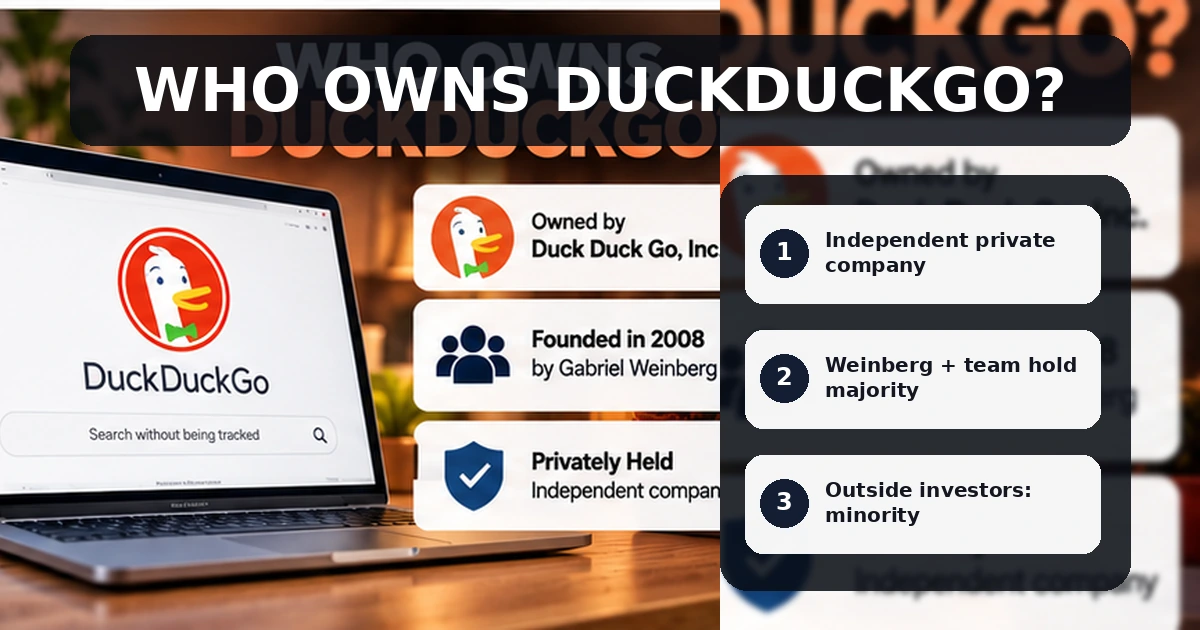
DuckDuckGo is owned by Duck Duck Go, Inc., a private American company with no parent. The company’s own help pages state it has been independent since 2008 and is majority-owned by founder and chief executive Gabriel Weinberg along with team members. Outside investors hold minority stakes. No valuation has been disclosed.
DuckDuckGo ownership at a glance
The table below covers the ownership facts that Duck Duck Go, Inc. and its investors have made public. Private companies are not required to file cap tables, so several figures remain undisclosed.
| Item | Detail |
|---|---|
| Ownership type | Private, founder-controlled |
| Parent company | None (independent) |
| Largest shareholders | Gabriel Weinberg and employees (majority); Union Square Ventures, OMERS Ventures, Thrive, GP Bullhound (minority) |
| Latest valuation | Not disclosed |
| Last funding round | $100M+, mainly secondary, disclosed June 2021 |
| Founded | 2008 |
| Headquarters | Paoli, Pennsylvania, United States |
| CEO | Gabriel Weinberg |
Who owns DuckDuckGo today?
Weinberg started the search engine in 2008 and funded it himself for the first three years. That gave him full equity before any investor arrived.
DuckDuckGo’s help pages, as of August 2026, describe the company as majority-owned by Weinberg and team members. Employees hold equity, and the company has never published the split between the founder’s shares and the employee pool.
The rest sits with venture and growth investors who bought in across three disclosed transactions. Union Square Ventures came in first, in 2011. OMERS Ventures followed in 2018. A larger group joined through the secondary sale that closed at the end of 2020.
No exact percentages are public. Duck Duck Go, Inc. files no annual reports with the Securities and Exchange Commission, and commercial databases disagree on the totals. That gap is normal for private companies, and it also applies to the ownership structure behind OpenAI, where the same reporting exemptions apply.
Who controls DuckDuckGo?
Ownership and control sit in the same place here. Weinberg is founder, chief executive, and majority shareholder, so voting power follows his economic stake rather than diverging from it through a dual-class structure.
DuckDuckGo has not disclosed a dual-class share arrangement, a voting trust, or a governance body of the kind used by some privacy and nonprofit-adjacent tech firms.
On the board, Union Square Ventures managing partner Brad Burnham joined when the firm invested in October 2011, according to TechCrunch. The company does not publish a current director list, so the full composition today is not on the public record.
Founder majorities of this kind are unusual after multiple rounds, since equity normally thins out. For context on the mechanics, see this breakdown of how founder stakes dilute across successive raises.
DuckDuckGo’s funding and ownership history
Weinberg bootstrapped the company from 2008 to 2011 before raising anything.
On October 13, 2011, Union Square Ventures led the first round, with angels including Scott Banister, Jim Young, Jeff Miller, Joshua Schachter, Kal Vepuri, Joshua Stylman, and Peter Hershberg. Terms were not disclosed at announcement. TechCrunch later put the round at $3 million, citing Crunchbase.
On August 29, 2018, OMERS Ventures, the venture arm of the Canadian pension fund, invested $10 million. TechCrunch described it as only the second round in the company’s ten-year history, earmarked for international growth.
The third transaction closed at the end of 2020 and was disclosed in a company blog post on June 16, 2021. It ran past $100 million and was described as mainly secondary investment, meaning early employees and backers sold existing shares rather than the company issuing new ones. In the same post, DuckDuckGo said it had been profitable since 2014, with revenue running above $100 million a year and an estimated 70 to 100 million users.
DuckDuckGo disclosed funding by round
Who are the biggest investors in DuckDuckGo?
Union Square Ventures has held a position since 2011, making it the longest-running institutional shareholder. OMERS Ventures led the 2018 round and returned in the 2020 secondary.
The 2021 disclosure named the participants in that transaction: OMERS Ventures, Thrive, GP Bullhound, Impact America Fund, WhatsApp co-founder Brian Acton, World Wide Web inventor Tim Berners-Lee, investor Freada Kapor Klein, and Lotus founder Mitch Kapor.
- Union Square Ventures, first institutional investor, 2011
- OMERS Ventures, $10 million round, 2018
- Thrive, GP Bullhound, and Impact America Fund, 2020 secondary
- Brian Acton, Tim Berners-Lee, Freada Kapor Klein, and Mitch Kapor, 2020 secondary
Stake sizes for each name are not public. The list is closer in shape to Anthropic’s mix of strategic and financial backers than to a single-lead cap table.
Is DuckDuckGo publicly traded?
No. Duck Duck Go, Inc. has no ticker and no listing on any exchange, and its shares cannot be bought through a brokerage.
The company has not filed for an initial public offering, and no registration statement has surfaced. Weinberg has not announced a listing plan, which keeps DuckDuckGo off the roster of private tech firms lining up for public listings. The 2020 secondary sale already gave long-held shareholders a way to sell without an exit.
FAQ
Who founded DuckDuckGo?
Gabriel Weinberg founded DuckDuckGo in 2008 and self-funded it until 2011. He is still the chief executive and, according to the company’s help pages, the majority owner.
Does Google own DuckDuckGo?
No. Google has never held a stake in Duck Duck Go, Inc. The company states it has been independent since 2008 and has never been owned by Google or any other entity.
Is DuckDuckGo owned by Microsoft?
No. Microsoft supplies some search results through Bing under a licensing agreement and has served ads on the site. A supply contract is not an ownership stake.
How much funding has DuckDuckGo raised?
Three transactions are public: roughly $3 million in 2011, $10 million in 2018, and more than $100 million disclosed in 2021. The last one was mainly secondary rather than new capital.
What is DuckDuckGo worth?
DuckDuckGo has never disclosed a valuation. It said in June 2021 that it had been profitable since 2014, with annual revenue above $100 million.
