
WhatsApp is owned by Meta Platforms, Inc., the Nasdaq-listed American company that bought it in 2014. WhatsApp has no shareholders of its own. It runs as WhatsApp LLC, a wholly owned subsidiary in Menlo Park, California. Meta’s market capitalisation was about $1.39 trillion on August 20, 2026.
WhatsApp ownership at a glance
| Ownership type | Wholly owned subsidiary of a public company |
|---|---|
| Parent company | Meta Platforms, Inc. (Nasdaq: META) |
| Largest shareholders of parent | Mark Zuckerberg (13.68% equity), Vanguard, BlackRock, FMR |
| Parent market cap | About $1.39 trillion (August 20, 2026) |
| Acquisition | Closed October 6, 2014, valued at about $21.8 billion |
| Founded | 2009 by Jan Koum and Brian Acton |
| Headquarters | 1 Meta Way, Menlo Park, California |
| Head of WhatsApp | Kunal Shah (from June 2026) |
| Parent CEO | Mark Zuckerberg |
Who owns WhatsApp today?
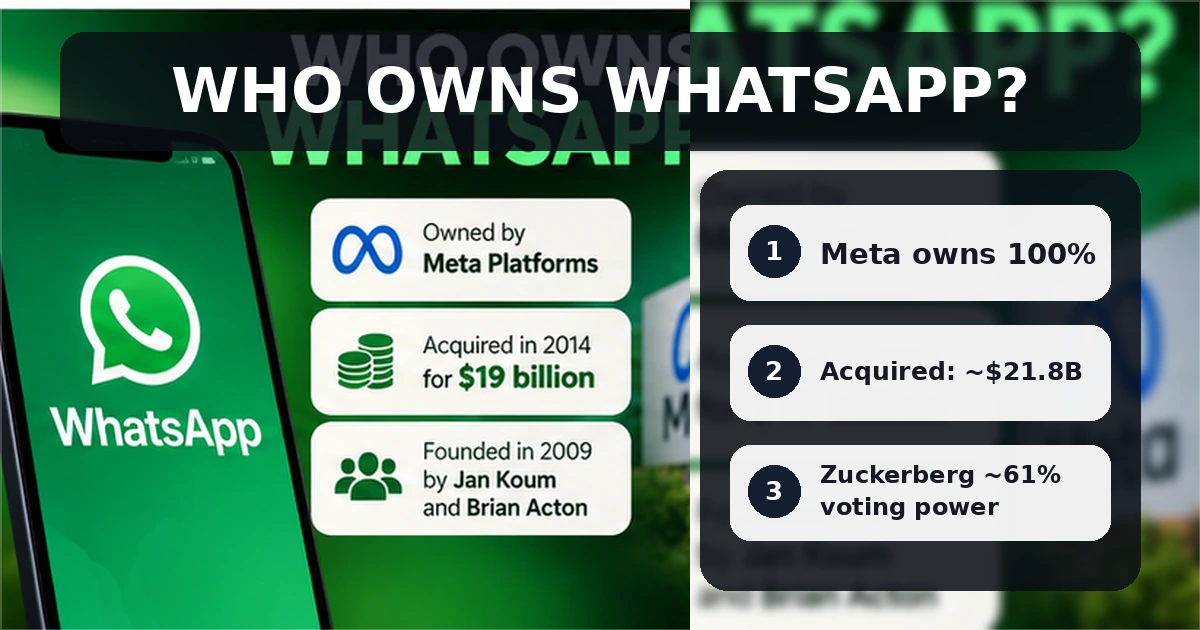
Meta holds 100% of WhatsApp. No venture firm, founder, or employee pool retains a stake, and there is no separate cap table to divide.
WhatsApp does not file its own accounts. Its results sit inside Meta’s Family of Apps segment, alongside Facebook, Instagram, Messenger and Threads.
Meta discloses one line that tracks WhatsApp closely. Family of Apps other revenue reached $1.0 billion in the second quarter of 2026, up 73% year over year, which CFO Susan Li attributed mainly to WhatsApp paid messaging and subscriptions. The same line totalled $2,584 million for full-year 2025.
Will Cathcart led the app from 2019 until June 22, 2026, when Meta named Cred founder Kunal Shah as head of WhatsApp. Shah reports into Meta’s executive team rather than to any WhatsApp board.
Meta Family of Apps other revenue by quarter, driven mainly by WhatsApp paid messaging ($M)
Who owns Meta, the company that owns WhatsApp?
Meta is a public company, so its shares are spread across index funds, asset managers and retail investors. Institutions held roughly 79% of outstanding shares in 2026.
Mark Zuckerberg is the largest individual holder at 13.68% of equity. Vanguard Group reported about 200 million shares as of December 31, 2025. BlackRock reported 167.5 million shares and FMR 130 million as of September 30, 2025, with State Street and Geode also among the top holders.
Those stakes buy economics, not authority. That is the opposite of the arrangement behind OpenAI’s ownership structure, where a nonprofit board sits above the commercial entity and no public shareholders exist at all.
Who controls WhatsApp and Meta?
Control at Meta is separate from ownership. Class A shares carry one vote each and Class B shares carry ten.
Zuckerberg holds 99.7% of outstanding Class B stock, which gives him about 61% of total voting power against an economic interest near 14%, according to Meta’s 2026 proxy statement. He is the deciding vote on every matter put to shareholders.
The May 27, 2026 annual meeting showed how that works in practice. All 12 board nominees were re-elected, and all ten shareholder proposals failed, with the strongest drawing 27% support. WhatsApp itself has no board, no independent directors and no minority holders to consult.
What else does Meta own besides WhatsApp?
Meta owns Facebook, Instagram, Messenger and Threads, plus the Reality Labs hardware division and Meta Superintelligence Labs, which holds 49% of Scale AI.
The company also takes minority positions. It invested $900 million in Cred for roughly 20% of the Indian fintech at the time it hired Shah. Its assistant products now run inside WhatsApp chats, an area covered in more depth in Meta’s AI product announcements.
How Meta acquired WhatsApp
Koum and Acton started WhatsApp in 2009 as a paid, ad-free alternative to SMS. Facebook announced the purchase in February 2014 at a headline price of $19 billion.
The deal closed on October 6, 2014 after European Commission clearance. Facebook paid $4.59 billion in cash and issued 177,760,669 Class A shares, plus 45,941,775 restricted stock units to employees. Share appreciation between announcement and close lifted the total to about $21.8 billion.
Bloomberg reported that WhatsApp had generated $10.2 million of revenue in 2013 against a net loss of $138.1 million. Koum joined the Facebook board on a $1 salary. Acton left in 2017 and Koum in 2018. The European Commission fined Facebook €110 million in 2017 over statements made during the merger review.
Is WhatsApp publicly traded?
No. WhatsApp has never listed and cannot be bought directly. Exposure to it comes through META shares on the Nasdaq.
A forced separation remains possible but unlikely on current rulings. Judge James Boasberg found for Meta in November 2025, and the FTC filed its appeal to the DC Circuit in January 2026, still seeking divestiture of Instagram and WhatsApp.
Readers comparing listed social platforms can see how Pinterest’s shareholders are split. Private companies weighing a listing are tracked separately among AI companies in the IPO pipeline.
FAQ
Who founded WhatsApp?
Jan Koum and Brian Acton founded WhatsApp in 2009. Both were former Yahoo engineers. Acton left in 2017 and Koum in 2018, several years after the sale to Facebook.
Does Facebook own WhatsApp?
Yes. Facebook bought WhatsApp in 2014 and renamed itself Meta Platforms in October 2021. Meta is the same corporate entity, so the ownership never changed hands.
How much did Meta pay for WhatsApp?
About $21.8 billion at closing on October 6, 2014. The February 2014 announcement priced the deal at $19 billion, and Facebook stock rose before the transaction completed.
Who runs WhatsApp now?
Kunal Shah, the founder of Indian fintech Cred, became head of WhatsApp in June 2026. He succeeded Will Cathcart, who moved to another product role at Meta.
Can I buy WhatsApp shares?
Not directly. WhatsApp has no listed stock. Investors gain exposure by buying Meta Platforms shares, which trade on the Nasdaq under the ticker META.
