
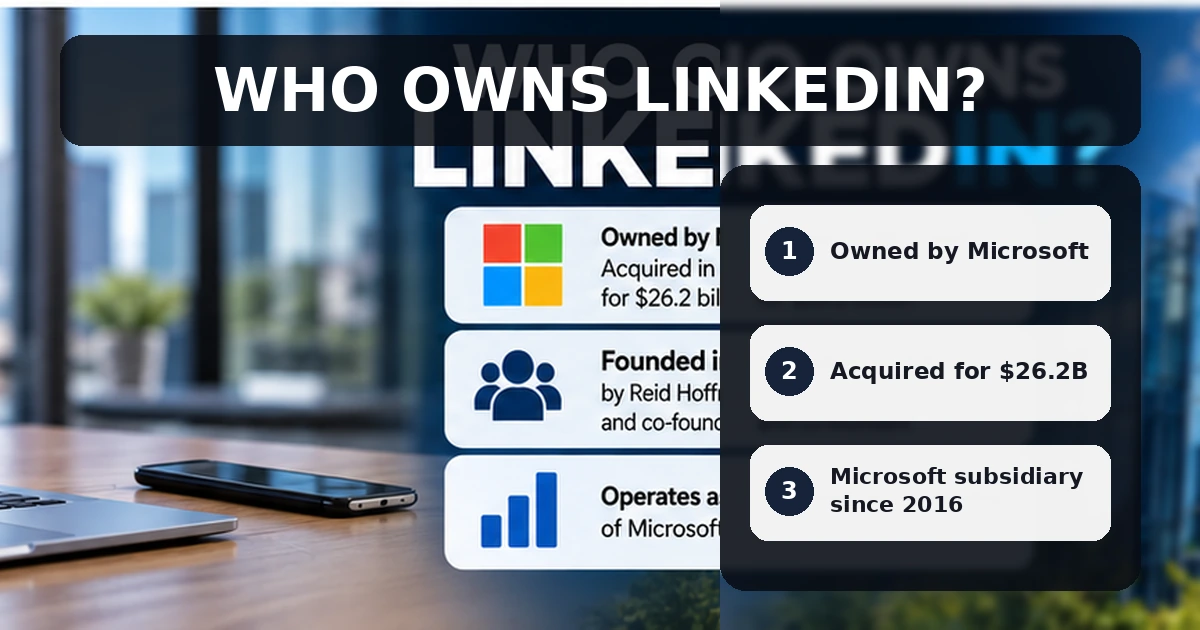
Microsoft owns LinkedIn outright. The Redmond company bought LinkedIn in an all-cash deal worth $26.2 billion that closed on December 8, 2016, and holds 100% of the equity. LinkedIn has no minority shareholders and no stock of its own. Microsoft trades on Nasdaq as MSFT and had a market capitalization near $3.58 trillion on August 18, 2026.
LinkedIn ownership at a glance
| Item | Detail |
|---|---|
| Ownership type | Wholly owned subsidiary |
| Parent company | Microsoft Corporation |
| Largest shareholders | Microsoft holds 100%; no other holders |
| Latest valuation or market cap | Not disclosed separately (Microsoft: $3.58 trillion, August 18, 2026) |
| Last funding round or acquisition | $26.2 billion Microsoft acquisition, closed December 8, 2016 |
| Founded | December 2002; site launched May 5, 2003 |
| Headquarters | Sunnyvale, California |
| CEO | Daniel Shapero, appointed April 22, 2026 |
Who owns LinkedIn today?
Microsoft has held every share of LinkedIn since December 2016. No venture firm, founder, or employee pool retains a stake, and no LinkedIn equity trades anywhere.
LinkedIn’s results roll into Microsoft’s Productivity and Business Processes segment, alongside Microsoft 365 and Dynamics. Microsoft reports LinkedIn revenue as a line item but does not publish the unit’s profit, assets, or standalone valuation.
Microsoft’s fiscal 2026 annual report recorded an 11% rise in LinkedIn revenue for the year ended June 30, 2026, with a 12% increase in the June quarter. The platform passed 1.3 billion registered members in April 2026.
Daniel Shapero became CEO on April 22, 2026, after five years as chief operating officer. He reports to Ryan Roslansky, who ran LinkedIn from June 2020 and now sits as a Microsoft executive vice president over LinkedIn and Microsoft Office. Shapero cut roughly 875 roles, about 5% of staff, on May 13, 2026.
LinkedIn revenue by Microsoft fiscal year (US$ billions)
Who owns Microsoft, LinkedIn’s parent company?
No person or firm controls Microsoft. Its shares carry one vote each, with no dual-class structure and no founder supervoting block, so ownership and control line up exactly.
Index managers hold the largest positions. As of December 31, 2025, Vanguard held 9.67% of shares outstanding, BlackRock 8.11%, and State Street 4.12%. Fidelity and Geode each held under 3%. Institutions together hold about three-quarters of the stock, and insiders under 0.1%.
Satya Nadella is chairman and chief executive. Because index funds vote with management in most contests, day-to-day authority over LinkedIn sits with Microsoft’s board and executive team rather than with any shareholder. That is the reverse of the setup before the sale, when Reid Hoffman’s Class B shares gave him 53% of the vote on 11% of the equity. Founder control of that kind is common in venture-backed cap tables, as this breakdown of founder equity and dilution shows.
What else does Microsoft own?
LinkedIn is one of several large acquisitions Microsoft has absorbed rather than spun out. Activision Blizzard cost $68.7 billion and closed in October 2023, the biggest deal in the company’s history. Nuance Communications closed in March 2022 at $19.7 billion.
GitHub was bought for $7.5 billion in stock in 2018 and still runs under its own name and chief executive, the same pattern applied to LinkedIn. Earlier purchases include Skype in 2011 and Mojang, the maker of Minecraft, in 2014.
Microsoft also holds a large minority position in OpenAI, extended in October 2025 and again in April 2026. That stake carries revenue-sharing and intellectual property rights rather than outright control, a distinction covered in this look at the OpenAI ownership structure.
Who are the biggest investors in LinkedIn?
LinkedIn has one investor today: Microsoft. Every earlier backer was cashed out at $196 per share when the deal closed in December 2016.
The company raised about $103 million across four private rounds before its listing. Sequoia Capital led a $4.7 million Series A that closed in November 2003. A $53 million round in June 2008 from Bain Capital Ventures, Sequoia, Greylock, and Bessemer valued the business just above $1 billion. Tiger Global put in $20 million in 2010.
Backers by voting power at the 2011 IPO:
- Reid Hoffman, co-founder, 21.7% of the vote
- Sequoia Capital, 19.3%
- Greylock Partners, 16.1%
- Bessemer Venture Partners, 5.2%
Hoffman’s stake was worth about $2.84 billion at the acquisition price. Compare that exit with Pinterest’s shareholder base, where the founders stayed public.
Is LinkedIn publicly traded?
No. LinkedIn traded on the New York Stock Exchange under LNKD from May 19, 2011, when it priced at $45 a share, until the Microsoft deal closed in December 2016. The ticker was retired then.
Buying MSFT is the only way to hold LinkedIn economically. Microsoft has not announced any plan to spin the unit out or relist it, which keeps LinkedIn off the current AI listing pipeline.
Frequently asked questions
Who founded LinkedIn?
Reid Hoffman founded LinkedIn in December 2002 with Allen Blue, Konstantin Guericke, Eric Ly, and Jean-Luc Vaillant. The site launched on May 5, 2003. Hoffman served as chief executive before moving to chairman in 2007.
How much did Microsoft pay for LinkedIn?
Microsoft paid $26.2 billion in cash, or $196 per share, announced June 13, 2016 and closed December 8, 2016. The figure included LinkedIn’s net cash and remains one of Microsoft’s largest acquisitions.
Does Reid Hoffman still own LinkedIn?
No. Hoffman sold his entire holding in the 2016 acquisition for roughly $2.84 billion. He holds no LinkedIn equity today and works as a partner at Greylock Partners.
Who is the CEO of LinkedIn?
Daniel Shapero became CEO on April 22, 2026, after serving as chief operating officer since 2021. He reports to Ryan Roslansky, a Microsoft executive vice president overseeing LinkedIn and Microsoft Office.
Can you buy LinkedIn stock?
Not directly. LinkedIn stock stopped trading in December 2016. Investors seeking exposure buy Microsoft shares on Nasdaq under the ticker MSFT, which include LinkedIn’s results and every other Microsoft business.
